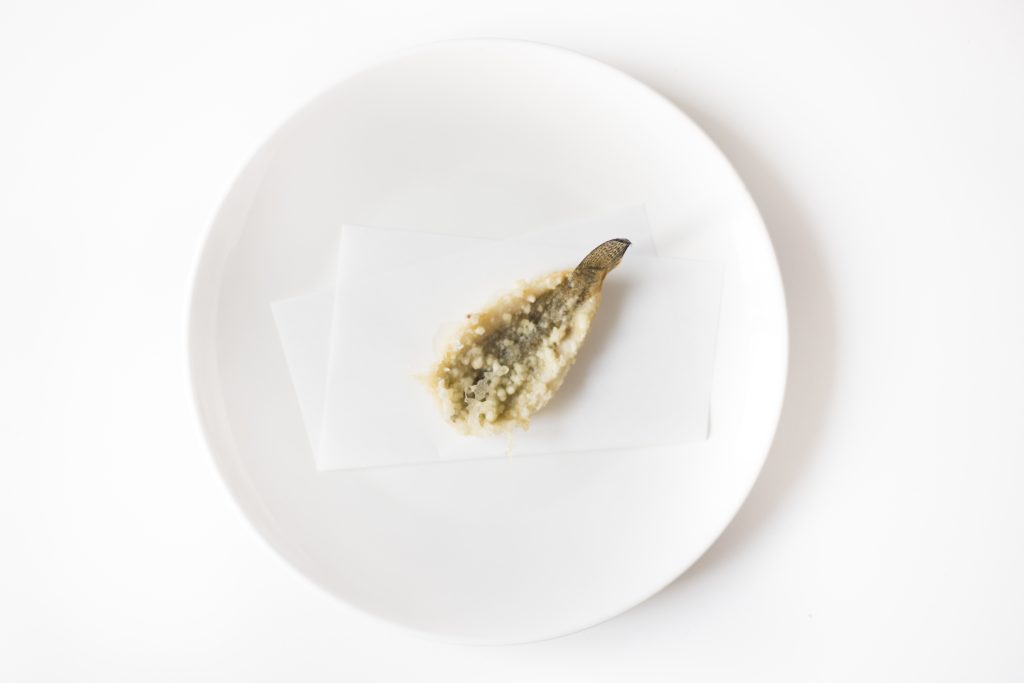
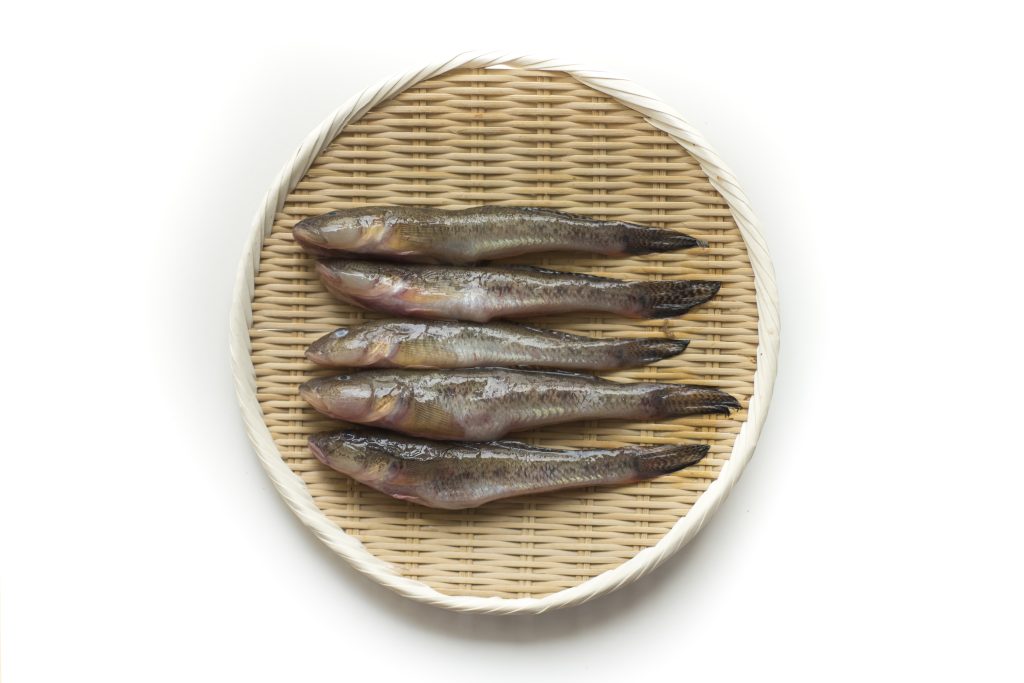
Once a quintessential staple at tempura restaurants, the Japanese Goby (haze/ハゼ/真鯊) would start appearing in markets just as the temperature started to drop in the autumn. Known as Acanthogobius flavimanus, they are part of the large Gobiidae family, and share the unique characteristic of having evolved pelvic fins that are fused together to form a disc-shaped sucker. This allows them to stick to stones or branches, preventing them from being washed away in fast-flowing water. They are commonly found in estuaries and brackish waters and live in large numbers, making them easy to catch.
Unfortunately, due to overharvesting and increased amount of pollution in rivers, the population of gobies in Japan have decreased dramatically, and it’s now rarer and rarer to find these fish at restaurants today. As a result, a once common fish available to everyday folk has started to become one that is harder and harder to find. Furthermore, it’s also started to lose popularity in restaurants, and is now only found in some of the most specialised restaurants.
We’d go so far as to say that it was equally a symbolic fish for tempura alongside anago, before the more common and easier to obtain Japanese whiting (Kisu/鱚) took over.
Just like many of the ingredients that are suitable for tempura, Japanese Goby filets are thin with a low amount of fat, making them perfect for cooking quickly in the oil. Unlike Ayu sweetfish, Goby is not cooked into tempura live, but many restaurants store live Goby that are dispatched only moments before frying. If the guts are not cleaned properly, they can retain a slightly muddy taste.
The Japanese Goby does not reach very large sizes. This combined with its soft scales means that it’s usually easier to scale it with the tip of a knife as a fish scaler can easily damage the flesh. The fish is usually butterflied from the back, with the rib bones being removed at the end. The bones of the fish are also quite soft, meaning that for smaller specimens, it’s usually not necessary to remove any pin bones. Most restaurants will cut out the rib bones right at the end, but we’ve heard of some home cooks who leave on the rib bones, which become soft enough during frying to eat.
How to fillet and prepare Japanese Goby
The preparation for Haze is similar to that of Aji, with the fish being butterflies from the back (背開き/sebiraki). The main difference is that the fish does not have a scaly spine like skin near the tail (zengo/ぜんご).
If starting from a live fish, quickly dispatch it by inserting the tip of the knife straight into the back nape of the fish.
For a neater appearance, cut the caudal fin of the fish to shorten it.
Using the tip of a knife, scale the entire body of the fish by running the knife against the scales. Be sure to get under the belly and pectoral fins of the fish.
Once scaled, slice off the head just behind the pectoral fin.
When the head is removed, the internal cavity of the fish will be revealed, allowing you to remove the innards by scoping them out with a finger and washing them with water.
To butterfly, start from the back of the fish near the head and dorsal fin, slicing through the flesh in long motions all the way down to the dorsal fin. However, do not cut all the way through the belly.
This should open up the fish like a book, with the spine still attached to one side of the fish. Gently slice under the spine and cut it off at the tip of the tail.
Flip your knife so that it is facing upwards and gently separate the rib bones from the flesh just where it meets the pin bones.
Turn your knife back and place the knife under the rib cage, cutting as to gently separate the rib cage from the flesh, angling the knife upwards towards the ribcage to reduce waste. Don’t worry about cutting yourself as the rib cage should be protecting your fingers. Cut with long slices until you can fully remove the rub bones and repeat for the other side.
Run your finger down the lateral line of the fillet. If the fish is large and the pin bones feel sharp, remove them with a tweezer. Otherwise, you can leave the pin bones in for smaller fish if cooking, but remove if serving raw.
Haze Tempura Recipe
- 1 egg (~50g without the shell)
- 200g of cold water
- 100g of cake flour
- Haze fillets
Once filleted, wrap the butterflied fish with fish paper or paper towels to remove any excess moisture.
Prepare the batter following our guide to tempura batter.
Heat your tempura oil in a pot to 180°C, coat the fish in batter and gently lower into the oil.
Fry until the bubbles emerging from the oil start to become smaller.
Remove from the oil and place onto tempura paper to remove any excess oil and serve immediately.
