To learn more about suppon, check out our series of articles.
If you’ve followed along our site on how to prepare fish for making sushi, you’ll notice the majority of fish are filleted as three pieces, the two fillets and bones. This is known as sanmai oroshi (三枚おろし) and works well for at least 99% of fish you’d ever encounter. Today however, we’re learning how to fillet Suppon (すっぽん), or Japanese soft shelled turtle, which of course is not a fish, but a reptile with very different morphology. In Japanese, the method used to fillet turtle is known as yottsutoki (四つ解き), meaning to separate into four pieces as after dispatching, the turtle is quartered into its four limbs.
Similarity with chicken
We’d like to think of filleting a turtle as very similar to breaking down a chicken. This may be due to coincidence, but we believe it probably has to do with reptiles and birds being in the same evolutionary clade as they share a common ancestor, and thus have similar characteristics. Just like with chicken thighs, you’ll make your life a lot easier by first locating the joints and making cuts though there, rather than trying to cut around bones.
Safety
Before we begin, we also want to emphasise some key points. Firstly, if you’re being a whole suppon from a market, chances are they’re still alive and sold in nets to stop them from escaping. Here, you want to be careful as just like any other turtle, they’re quick to take a snap at your hands if you’re not careful, which will be an excruciating experience. And unlike lobsters sold in the west with their claws bound, suppons are just sold as is. There is a Japanese saying that once a suppon bites, it will not let go until thunder rumbles: 「すっぽんは噛み付いたら雷が鳴るまで離さない」, and whilst this is an exaggeration, it is still a warning to us. We’ve been told at restaurants that if you put the suppon back underwater or hold still for around 10 minutes the suppon will release its grip but we’d always recommend seeking medical attention if you get bitten by a turtle that won’t let go.
To quickly dispatch a suppon, you’ll want to grab its neck and make a quick incision to sever the spine to kill it, then only cut off the head in its entirety. This can either be done from the top or bottom of the neck depending on what you’re comfortable with. Most turtles and tortoises have the same instinctual response when flipped on their back, which is that they extend their heads to try to use it as a lever to flip themselves back up. In a restaurant, we take advantage of this by deliberately flipping the turtle on their back on a chopping board, causing them to extend their head so that we can grab it and dispatch them. I’ve seen one other chef do it another way, whereby they roll up a towel and let the turtle bite into the towel, before the chef pulls the towel to extend out its neck to dispatch it.
Not for The Faint of Heart
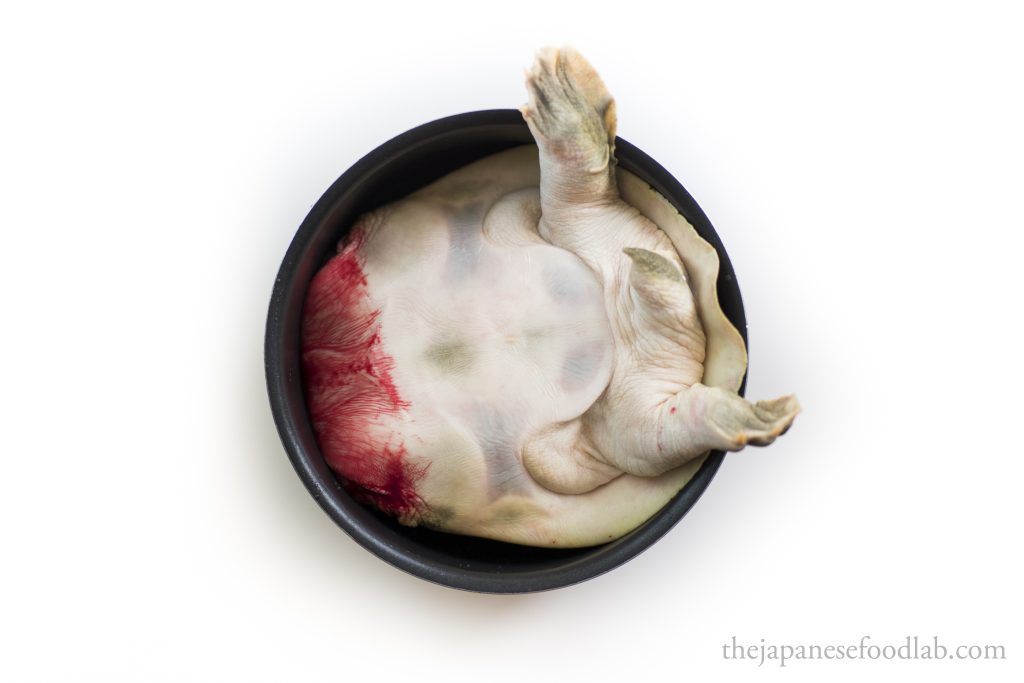
This leads us to our next part, which is that the entire process is quite bloody, even more so than filleting eels. Therefore, if you’re not comfortable with this, you’re better off either asking the fishmonger to fillet the turtles first, or see if you can buy them pre-cut from a high-end Japanese supermarket. The moment you cut off the head of the turtle, for a few moments the heart will continue to pump and a lot of blood will immediately start gushing out. Here, you have two options. You either do this entire process over the sink so that you can tip all the blood down the drain or immediately hold the headless turtle up right so that the blood doesn’t go everywhere, and then carry it over to a bowl and tip out all the blood for other culinary uses. Either way, you must drain out the blood from the turtle before you can proceed with filleting it.
Drinking Suppon Blood
At some restaurants, the fresh blood is mixed with sake as a medicinal drink, and for non-alcoholic drinkers, apple juice or sometimes orange juice in a ratio of 4:1 liquid to blood. Please remember that drinking raw blood like this is very dangerous if careless done. The suppon sourced in Japan are most commonly farmed under strict hygiene regulations and restaurants that serve the blood of wild suppon have connections with suppliers and hunters who have many years of experience handling such product.
Inedible Parts of a Suppon
While no part of a suppon is poisonous, there are certain parts that impart bitter tastes to the dishes, or are unpleasant to eat because of the texture.
Unique to suppon, the oesophagus has a tough texture and supposedly muddy taste and is usually discarded. It is attached to the lower jaw of the suppon so usually 2 incisions are made in a v-shaped pattern to cut out the jaw, before the entire oesophagus is pulled out in one go. The bladder and urethra of the suppon are usually not eaten, with the urethra removed by cutting the tail short by 1 to 2 cm.
The same as many fish and eels, the gall-bladder contains bile, a digestive fluid produced by the liver. It is easily recognised as a small usually dark green round-ish organ. The bile itself is extremely bitter and so the entire gall-bladder is usually discarded. Care should be taken to not puncture the gall-bladder during filleting as you do not want the bile to come into contact with any of the precious flesh.
The entire suppons is also covered with a thin outer layer of skin which is unpleasant to eat, no matter how long the suppon is cooked for. The mistake beginners make when trying to remove the skin is to blanch the suppon in boiling water to make it easier to peel. While this does work, the skin then breaks up into many small pieces. Instead, a temperature of 80 to 90°C is optimal as it softens the skin without causing it to break up.
Special Parts of a Suppon
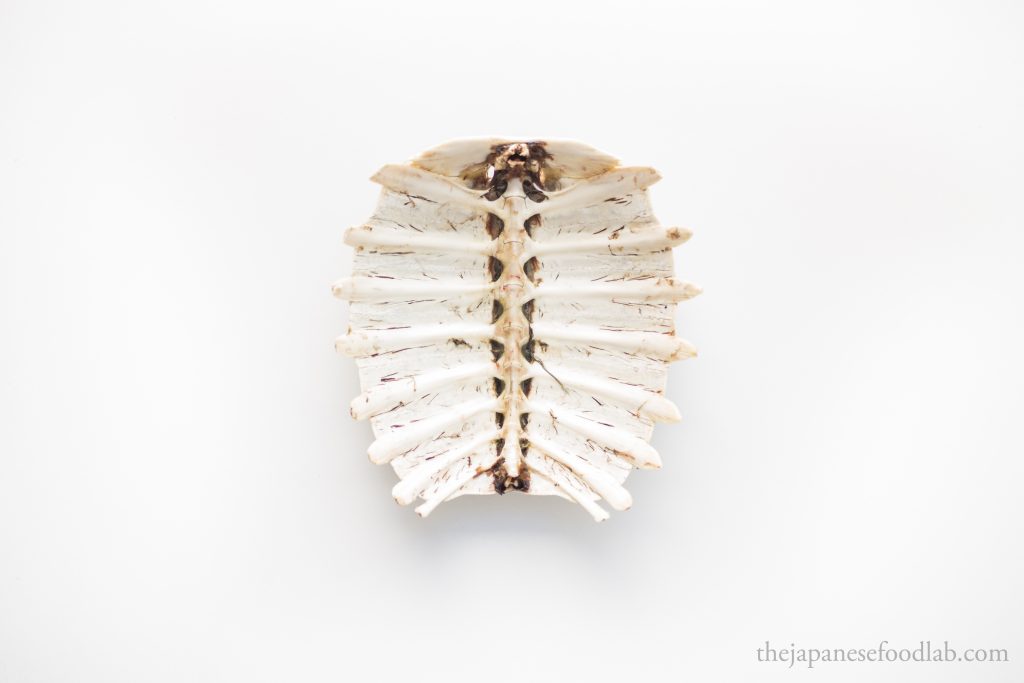
Probably the most defining feature of a suppon is that its shell is not keratinised like most turtles and tortoises, meaning that instead of a hard shell, it has a soft malleable shell that can easily be cut with a knife. While the centre of the shell still contains bones, the surrounding edges of the shell are rich in collagen. Known as empera (エンペラ), it is what make extremely rich and lip smacking soups of which suppon is most famous for. When cut up, each limb of the suppon should still have a small piece of empera attached.
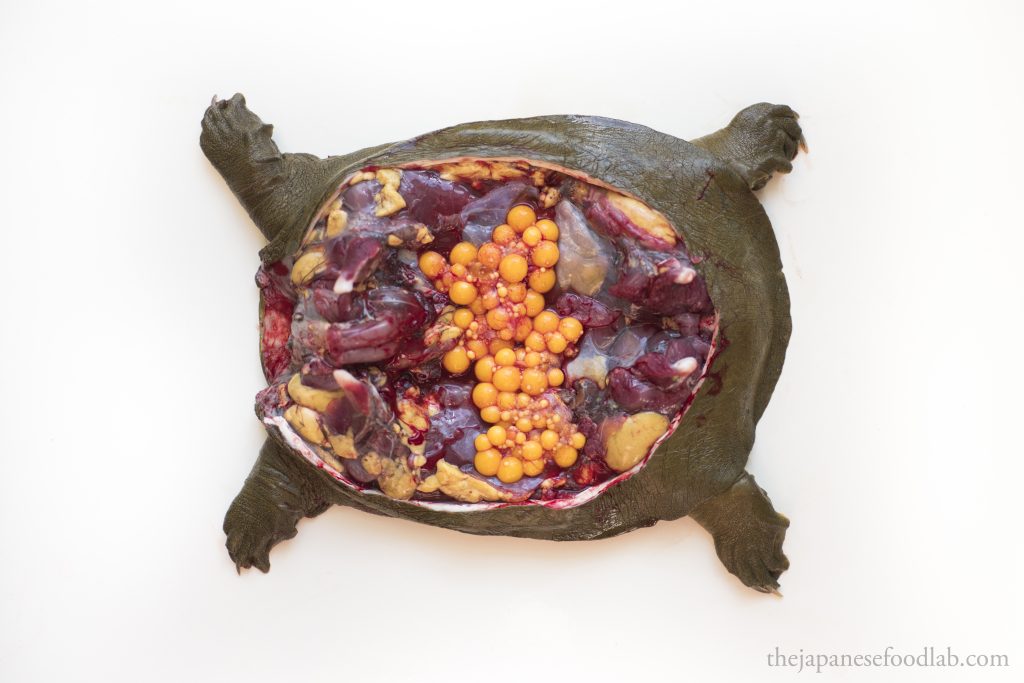
Some restaurants also differentiate between male and female turtles when ordering as female turtles sometimes still have unlaid eggs inside their bodies, which is highly desirable (similar to chicken tamahimo). For makes, the equivalent testes can also be eaten.
From the innards, the liver is usually eaten, and the stomach sometimes also eaten after being washed out.
How To Fillet a Suppon
First, lay the turtle on its back, causing it to extend out its neck.
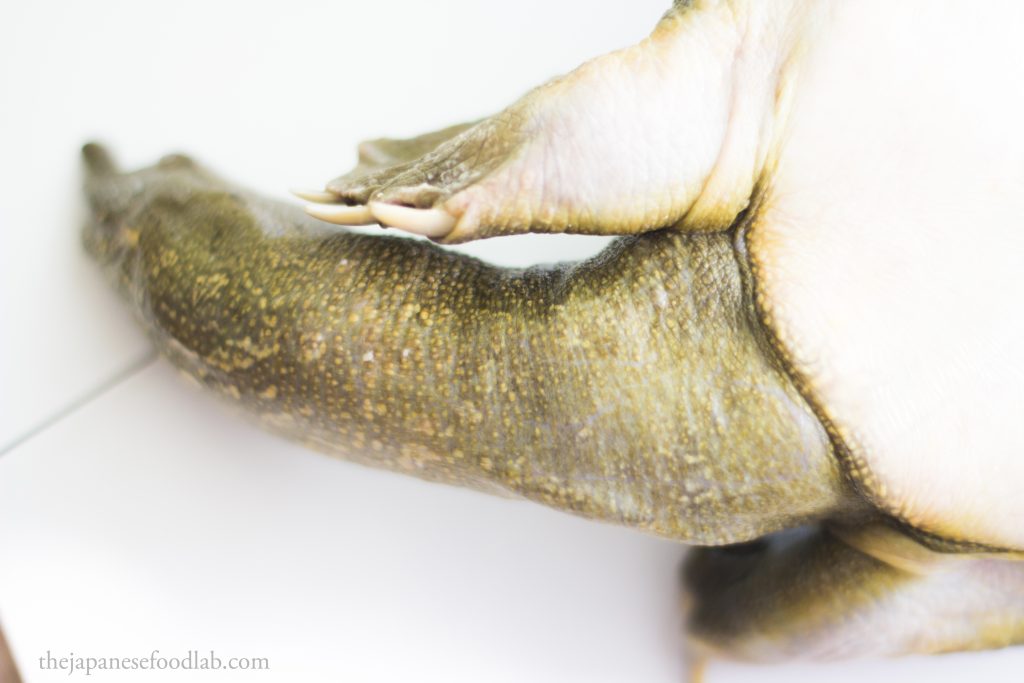
Grasp the neck firmly with one hand and use the other to insert a sharp knife just where the neck meets the shell. Cut through the neck to sever the spine and kill the turtle.
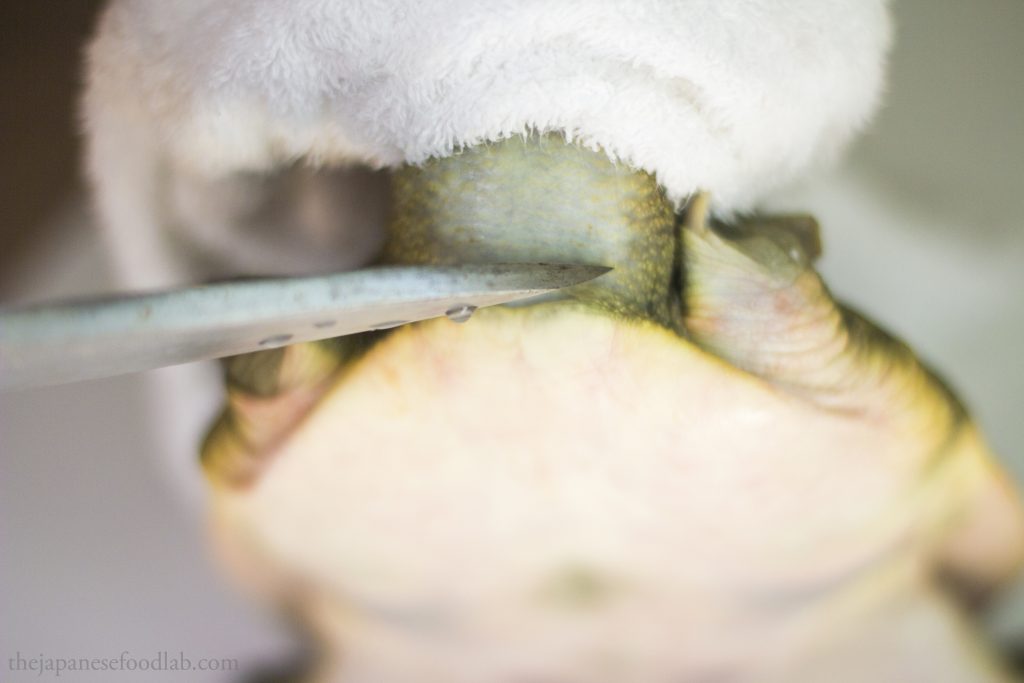
Lay the turtle flat on the chopping board and quickly cut off the head and neck from the body.
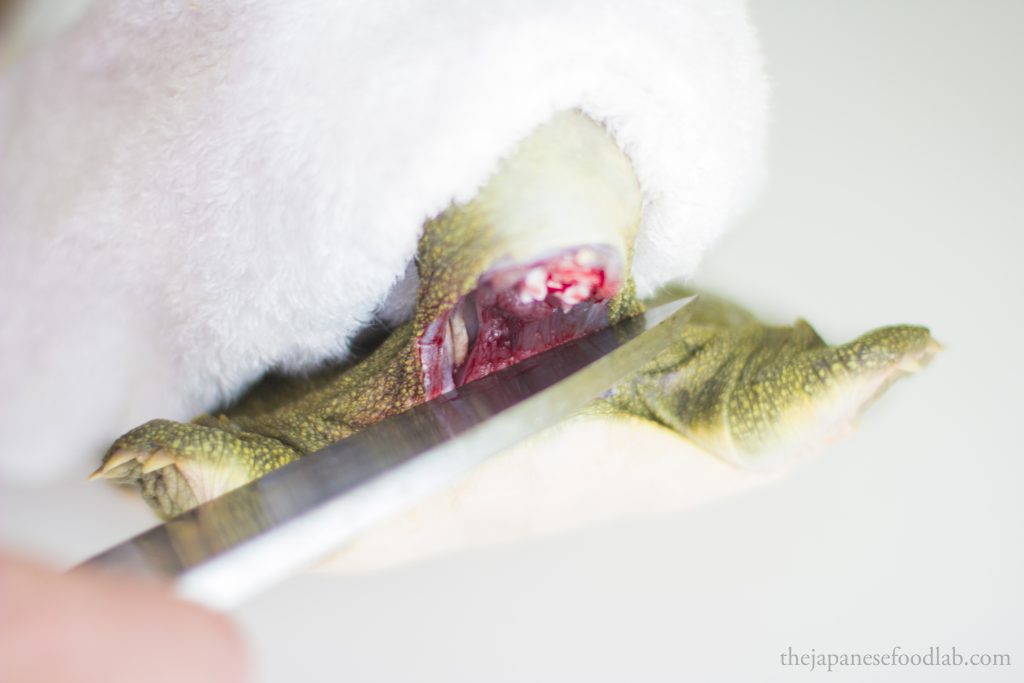
Tip the body into a bowl to allow the blood to drain.
In the meantime, we want to separate the inedible head from the edible neck. Lay the head upside down and make two cuts in a v-shape along the jawbone.
The first cut for the v-shape.
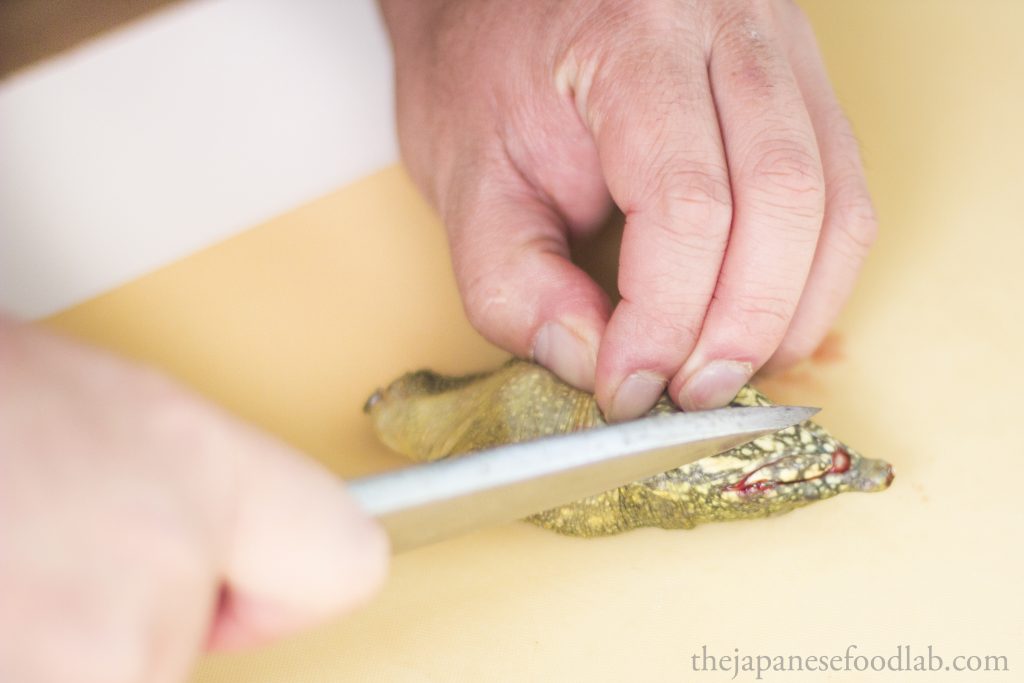
The second cut for the v-shape.
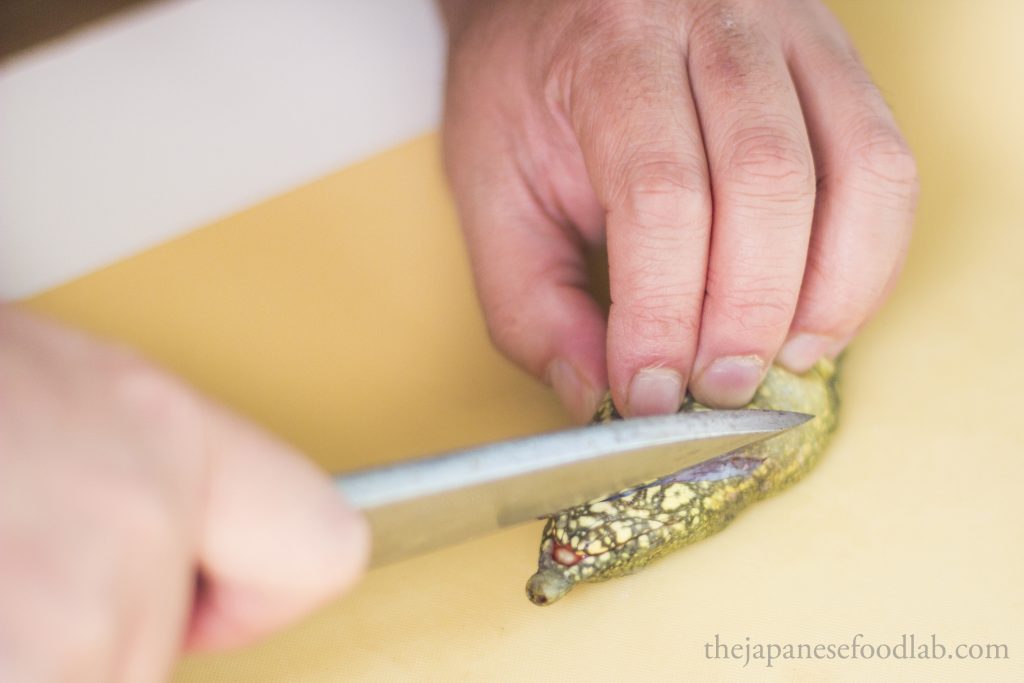
If needed, make another cut beneath to release the head.
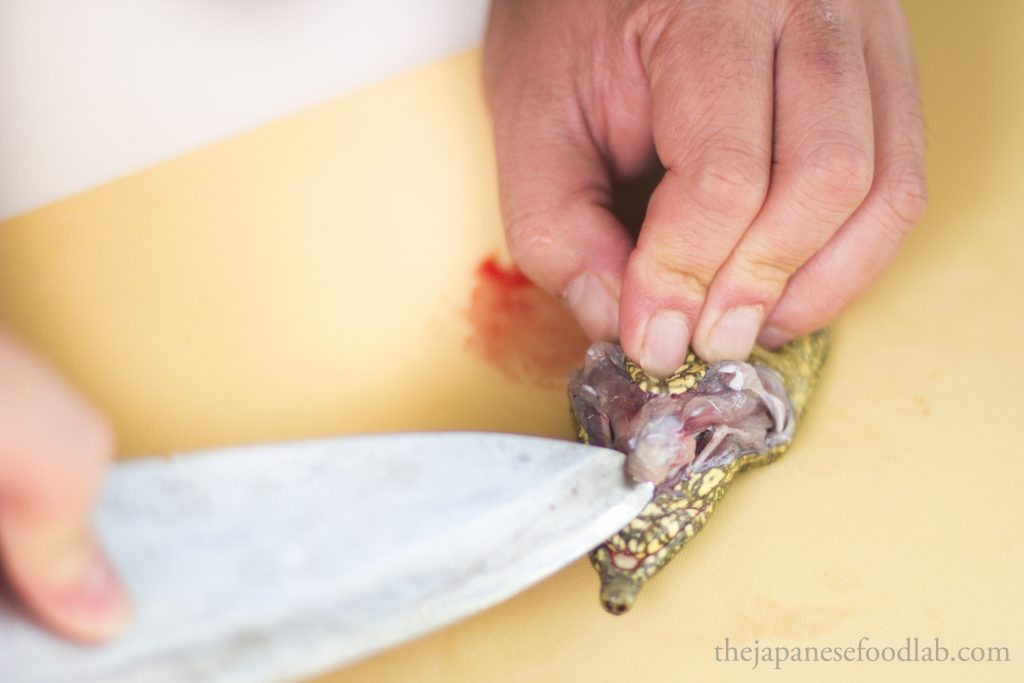
Insert the knife through the v-shape cut and cut downward at an angle.
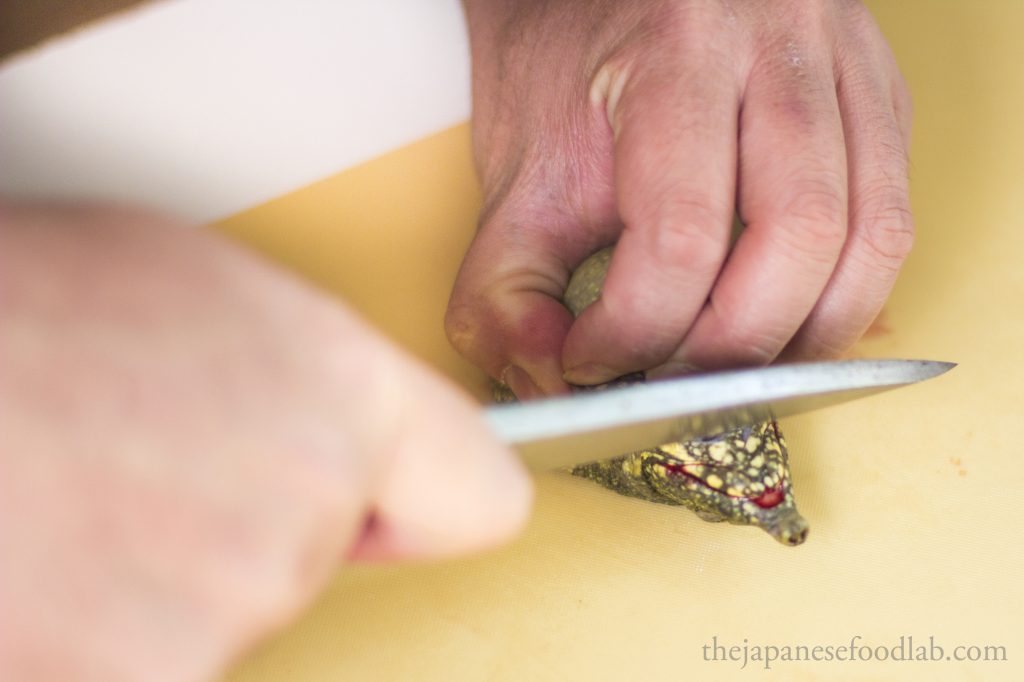
You can pull the jawbone back to make it easier to cut though.
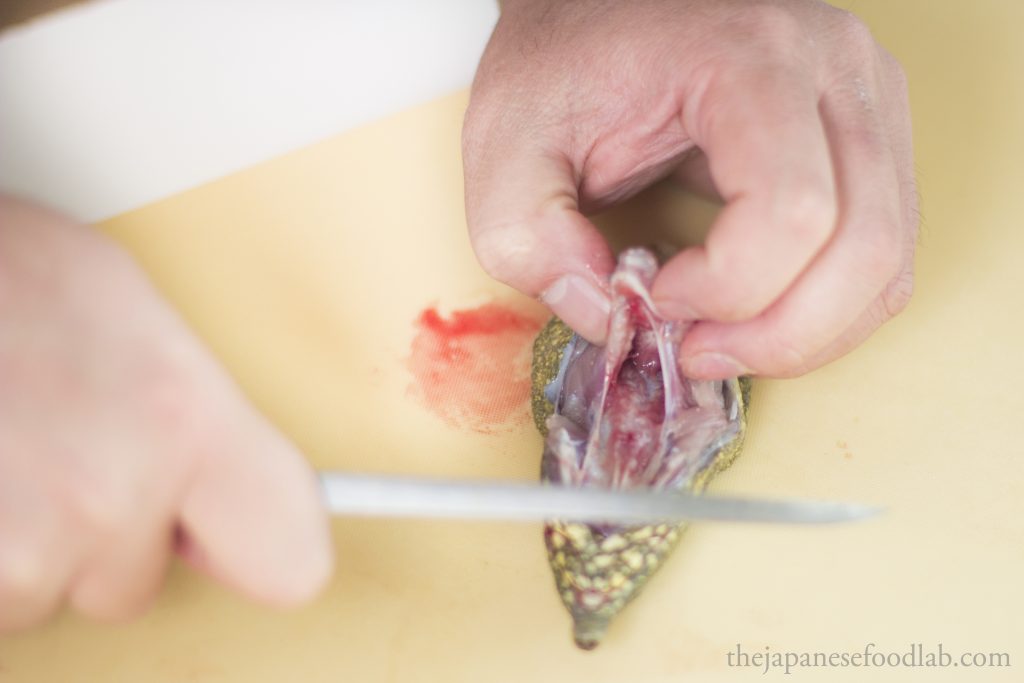
Continue cutting until the head is seperated from the neck.
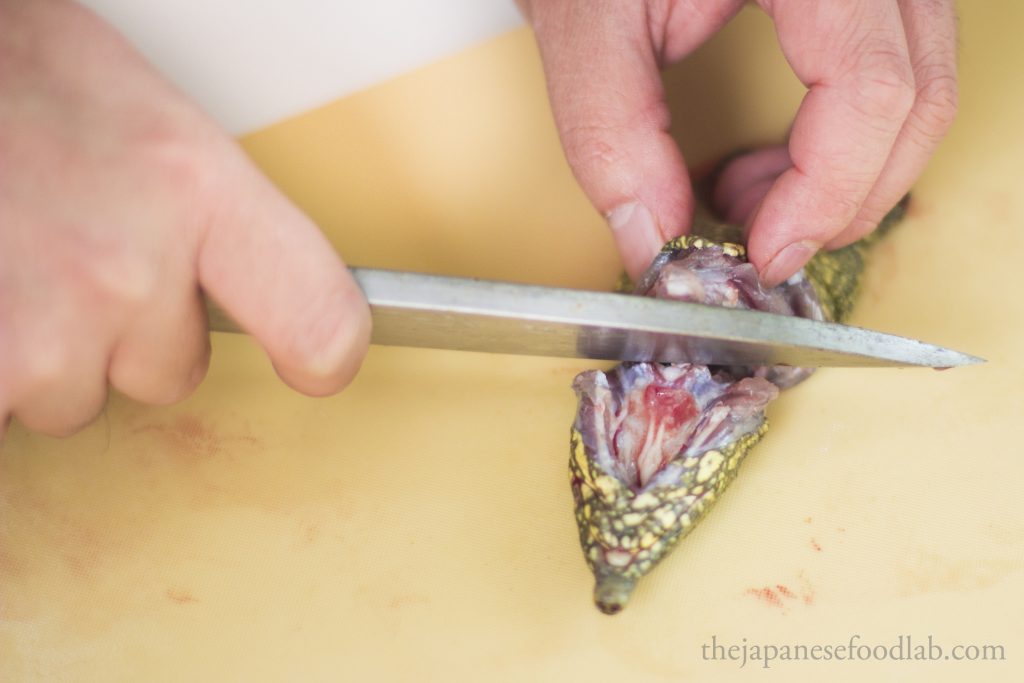
Now you should be left with the neck and the jawbone attached. The reason we leave the jawbone is that it is attached to the oesophagus, and we want to pull that out of the neck.
Flip the neck upside down so that the jawbone is facing upwards, and cut on either side of the jawbone. Do not cut all the way through.
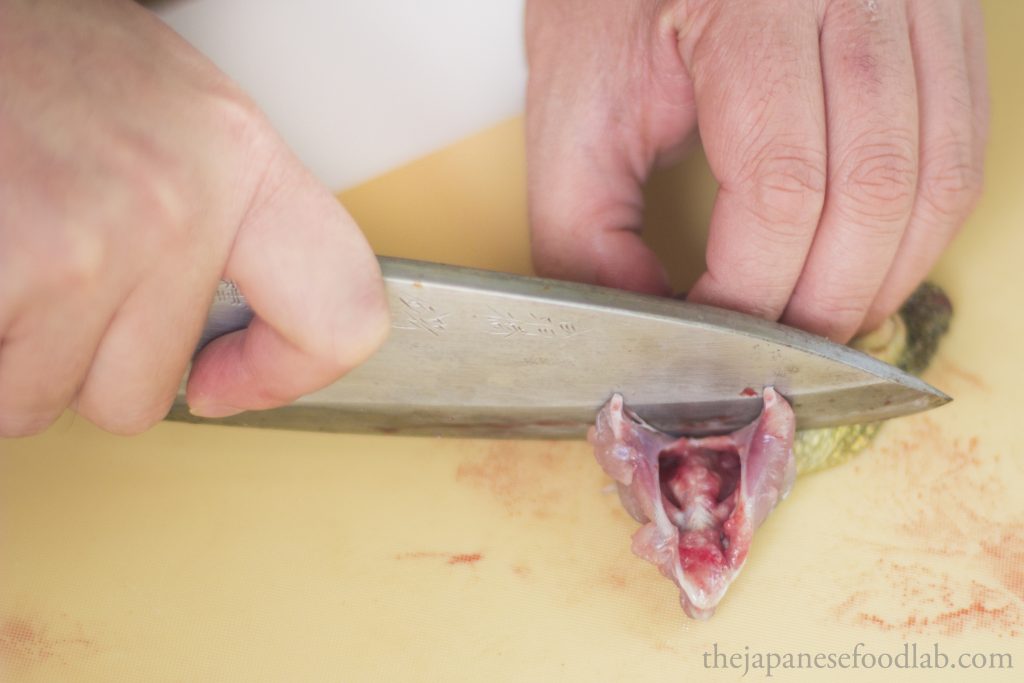
Using the knife, pull the jawbone away from neck with your knife in order to pull out the oesophagus in one go.
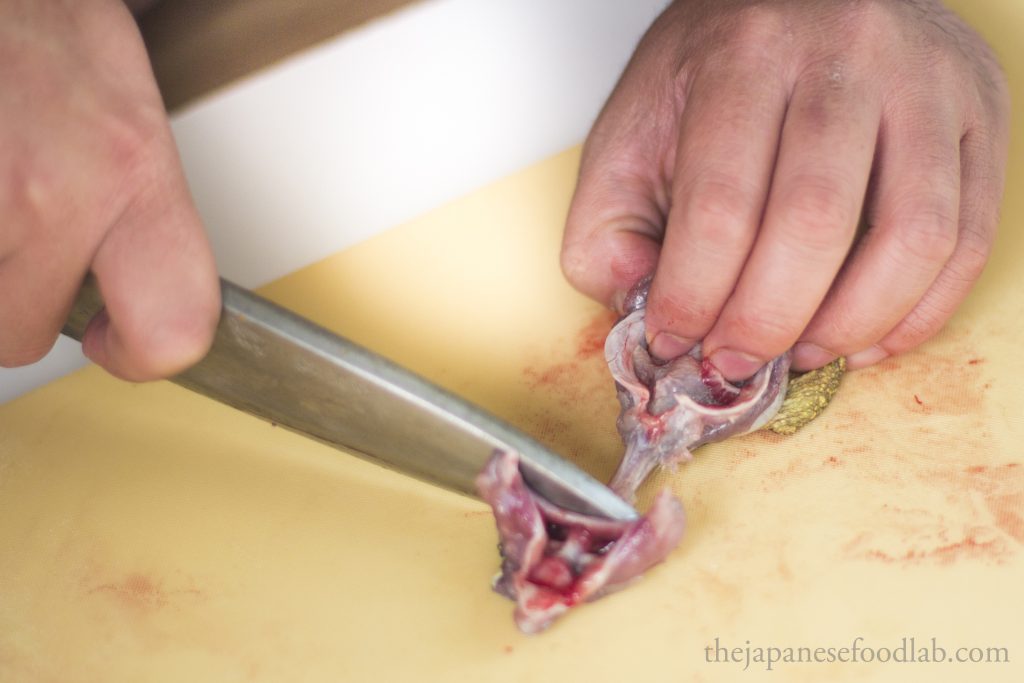
Once the blood from the body has drained, you’ll open up the turtle by cutting around the carapace between the empera. Begin by cutting through the empera until your knife hits the card carapace.
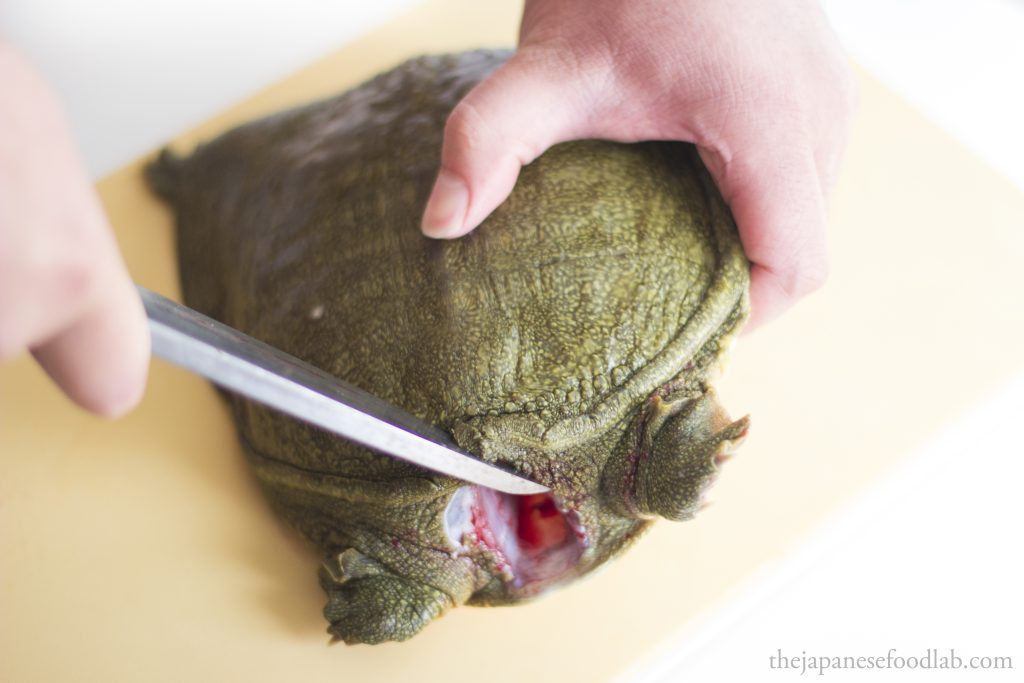
Once it does, begin cutting along the carapace, rotating the turtle as you go, similar to opening a can of soup. Note that the carapace is not centred directly in the middle of the empera and that there is a lot more empera towards the tail end of the turtle.
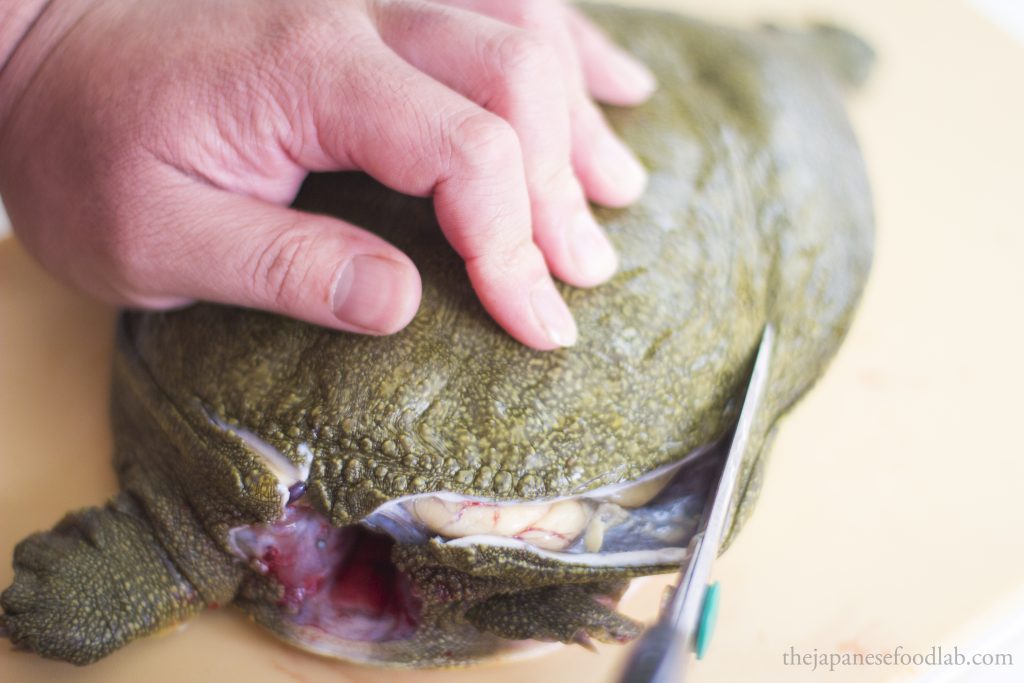
If you are worried about this step, the empera is soft enough that a pair of sharp kitchen scissors also works.
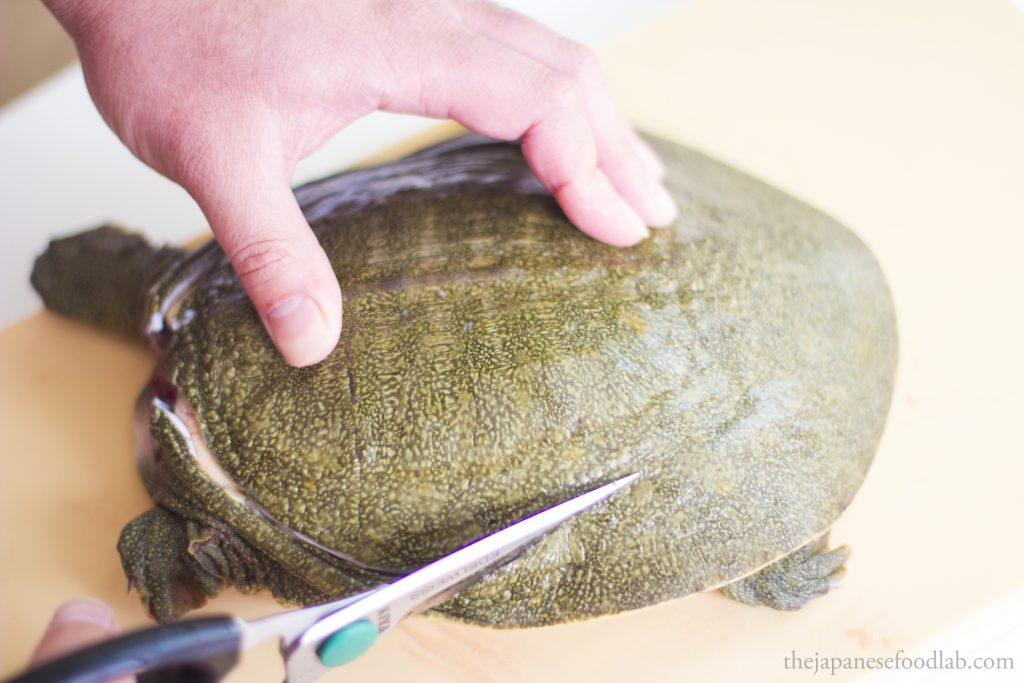
Continue until the entire carapace is cut all around.
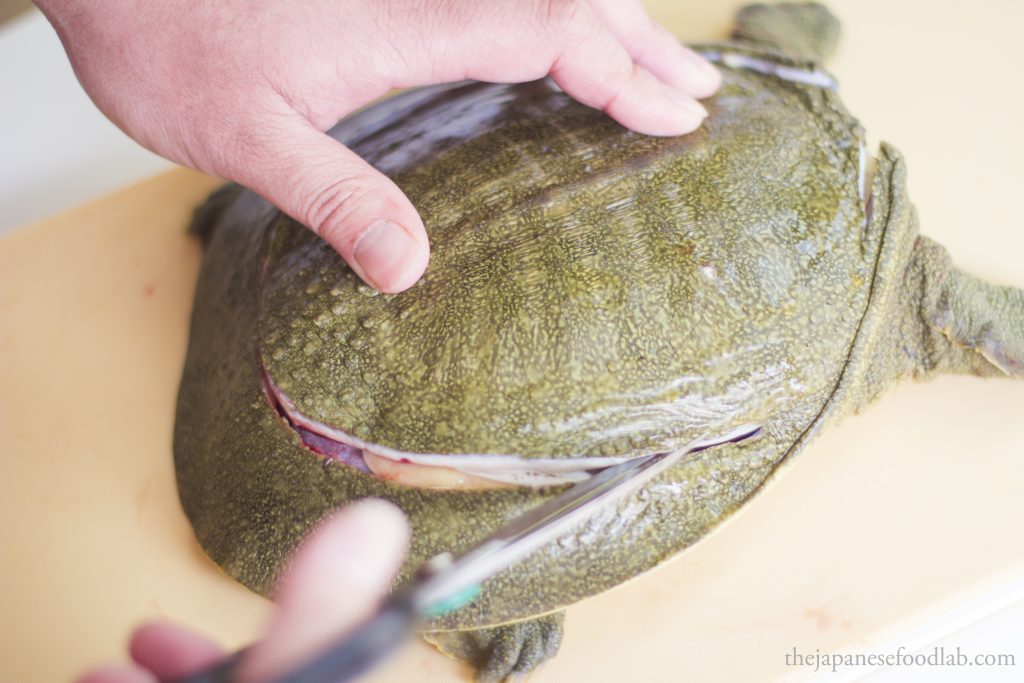
To remove the carapace, you’ll need to cut along the underneath of the carapace in long strokes to release the membrane attaching it to the body. This is similar to shucking scallops if you’ve done that before. Do not discard the carapace as it is used in soups.
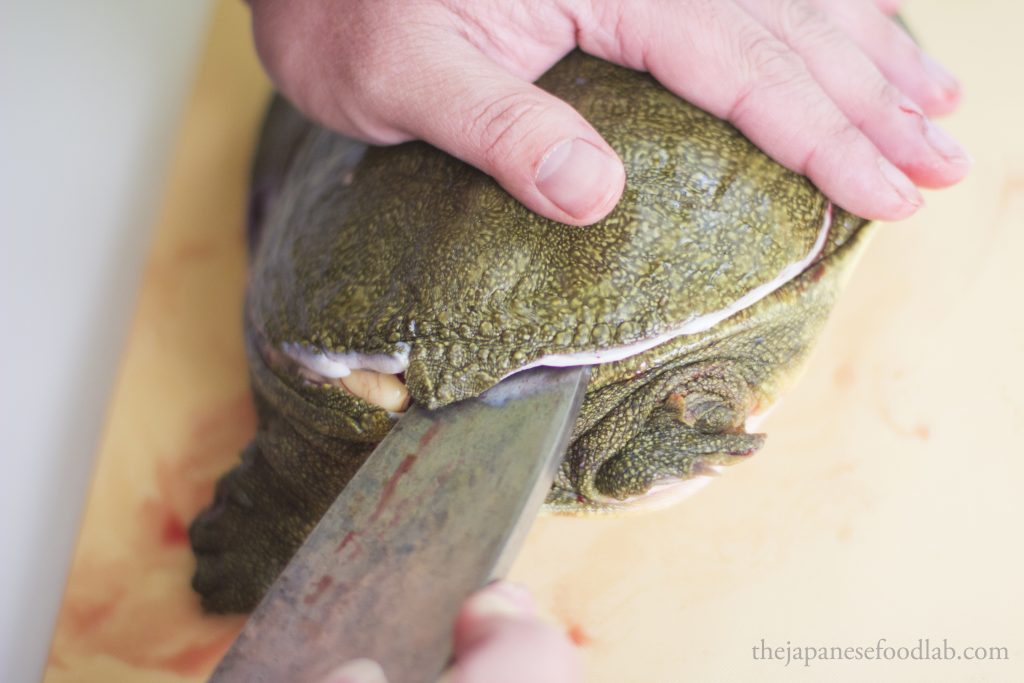
Once the carapace is removed, you’ll be able to see all the internal organs covered with a protective membrane.
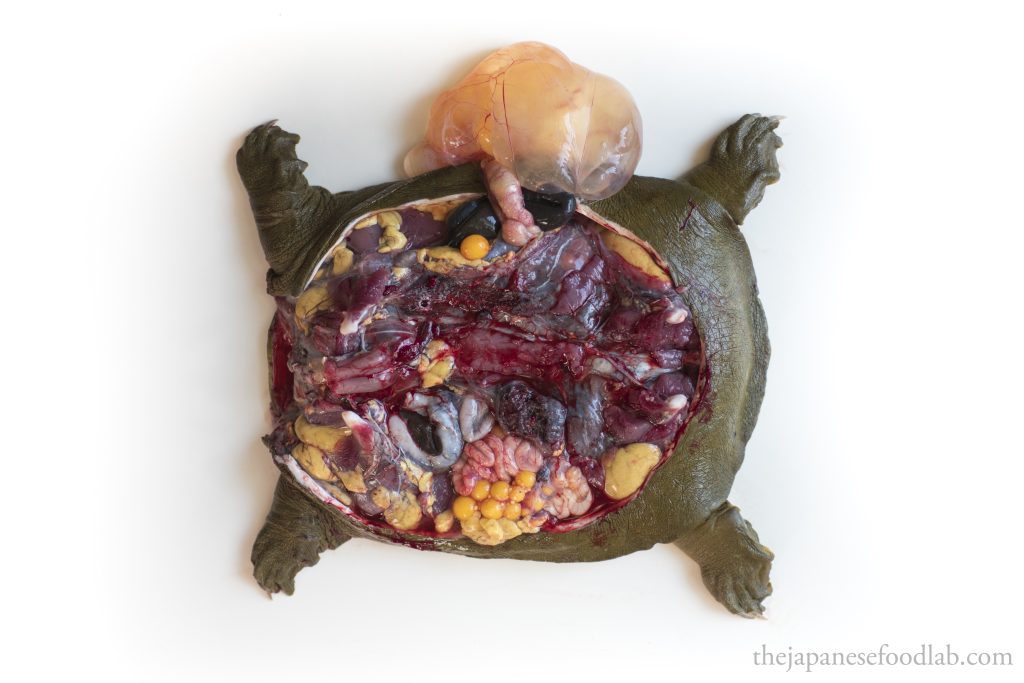
Starting at the tail end, make a cut in the membrane and use your hands to gently pull out the organs, careful not to break any.
Wash out the insides of the turtle before continuing.
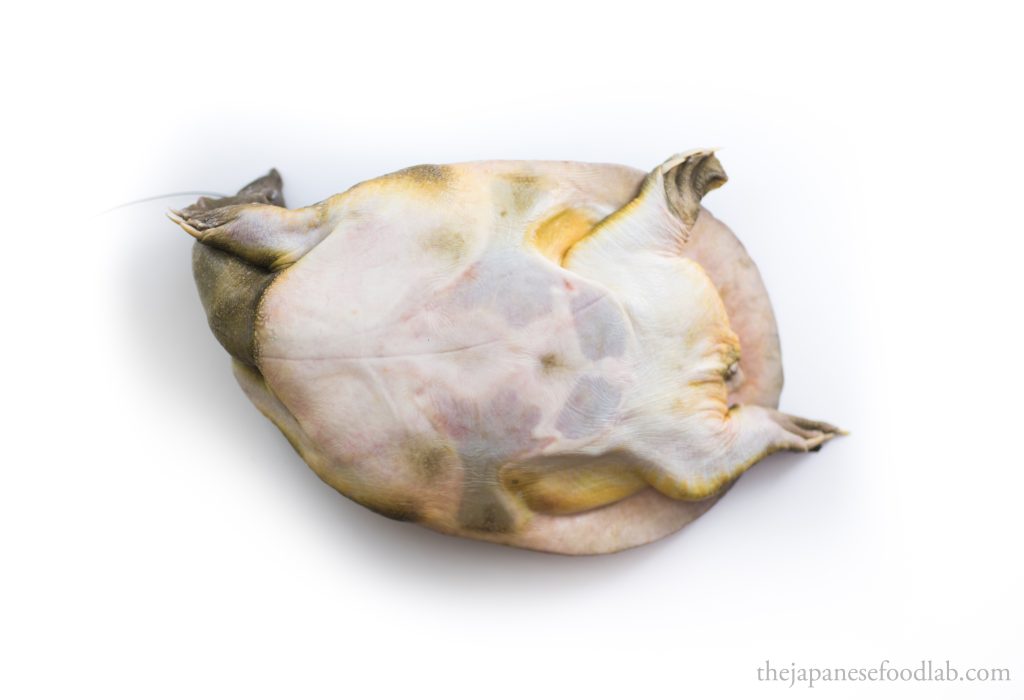
You’ll notice that other than the thick hard carapace on top of the turtle, there is also a hard layer underneath the turtle known as the plastron. The two hind limbs of the turtle protrude out from above the plastron.
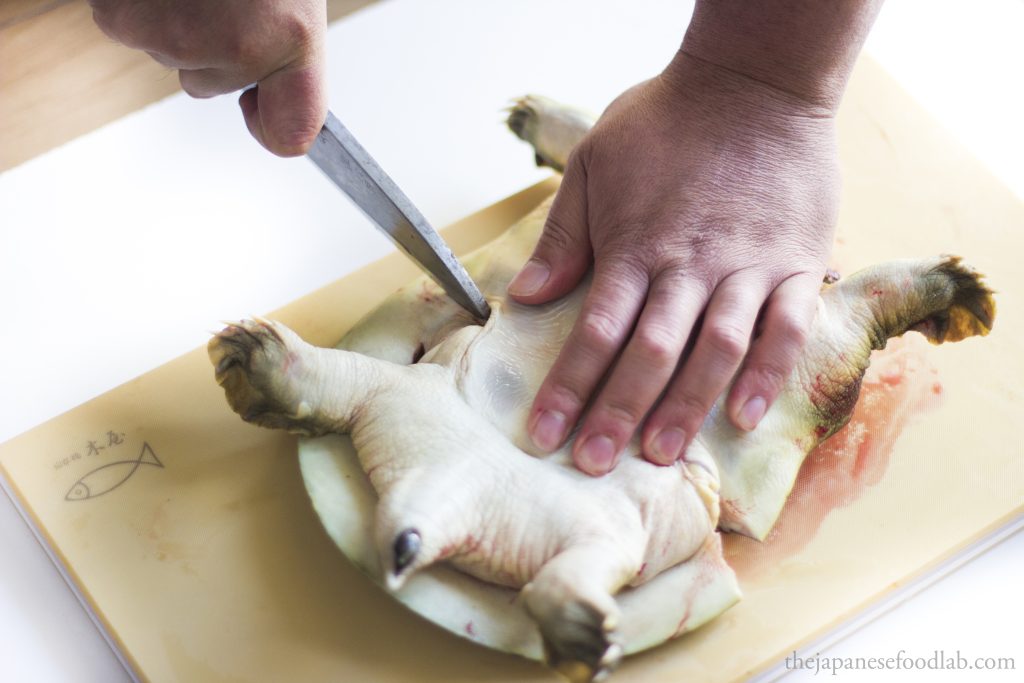
Turn the turtle over and cut under both hind limbs from both sides from underneath the plastron.
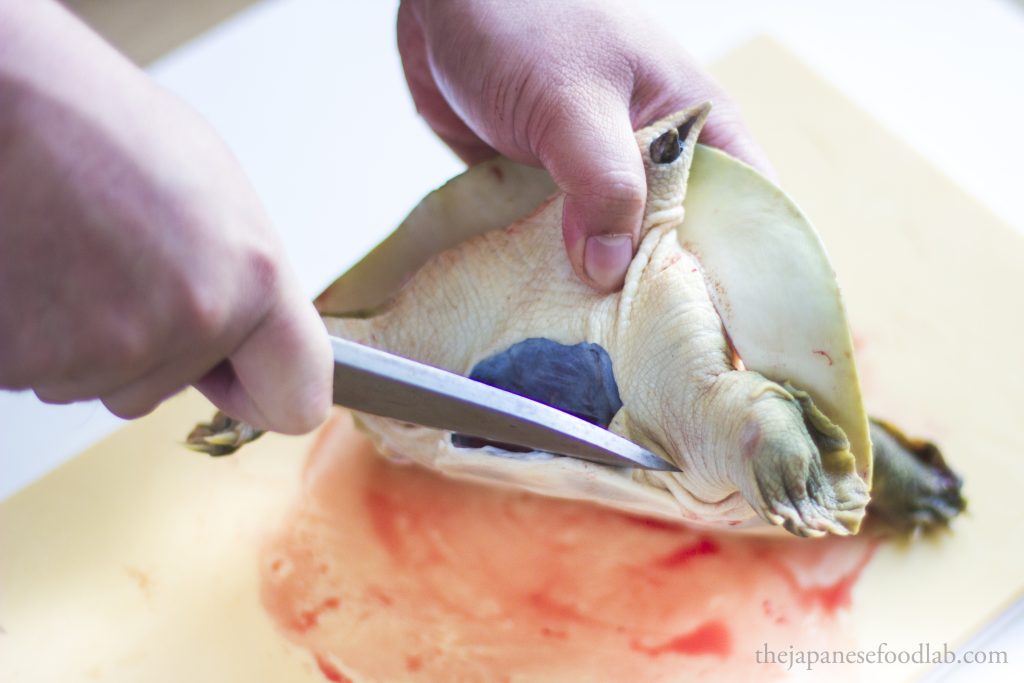
Insert a knife between the pastron and flesh and use long slices to cut away the plastron, before pulling away both limbs and the tail.
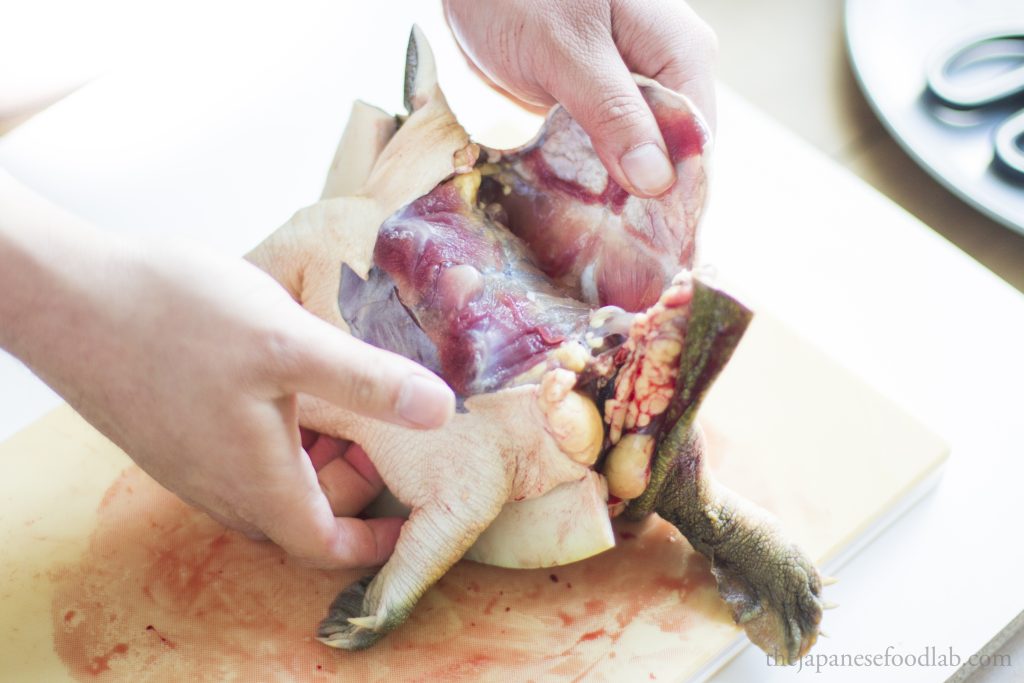
Continue pulling until seperated.
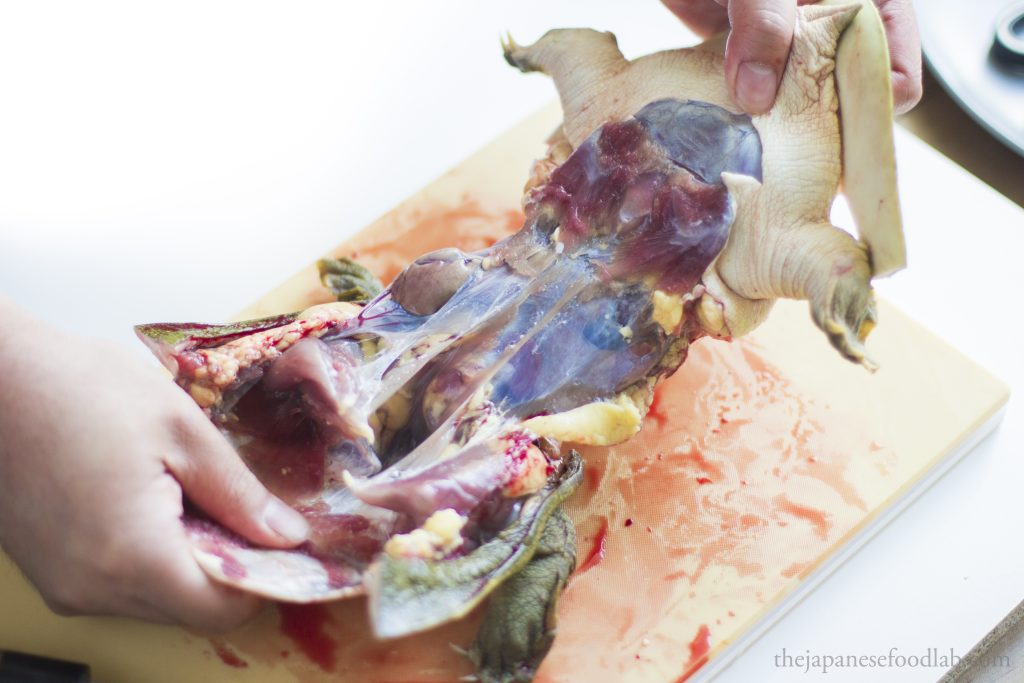
At this point, it should look like the image below.
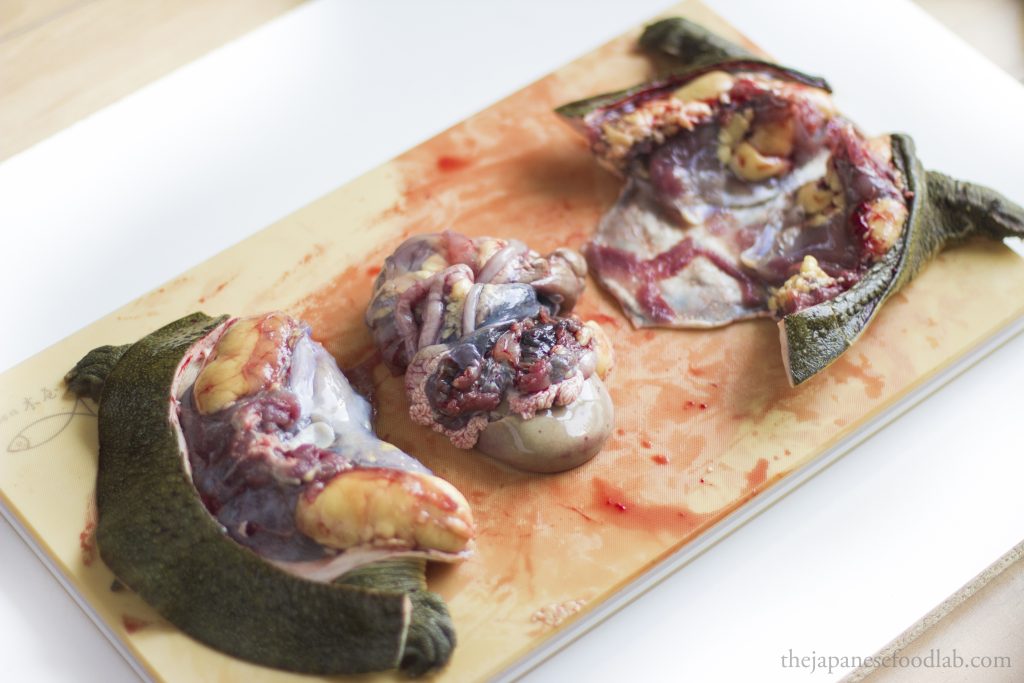
Attached to the liver you’ll see the dark green gallbladder which needs to be discarded. Underneath the liver you’ll find the heart, which if you’re quick enough will still be beating. The heart and liver are edible but not always served. Cut off the two testes if male or the unlaid eggs if female and gently rinse in water to extract any excess blood.
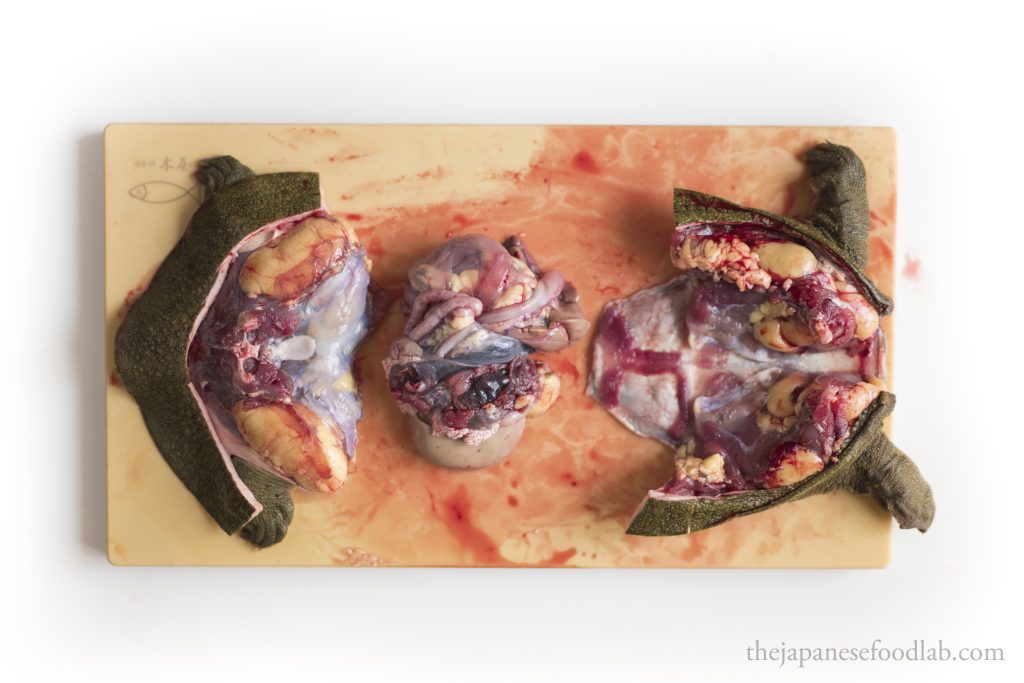
With the piece you have just pulled away, cut away the left and right hind leg at the joints, leaving just the tail section.
The left hindleg being removed.
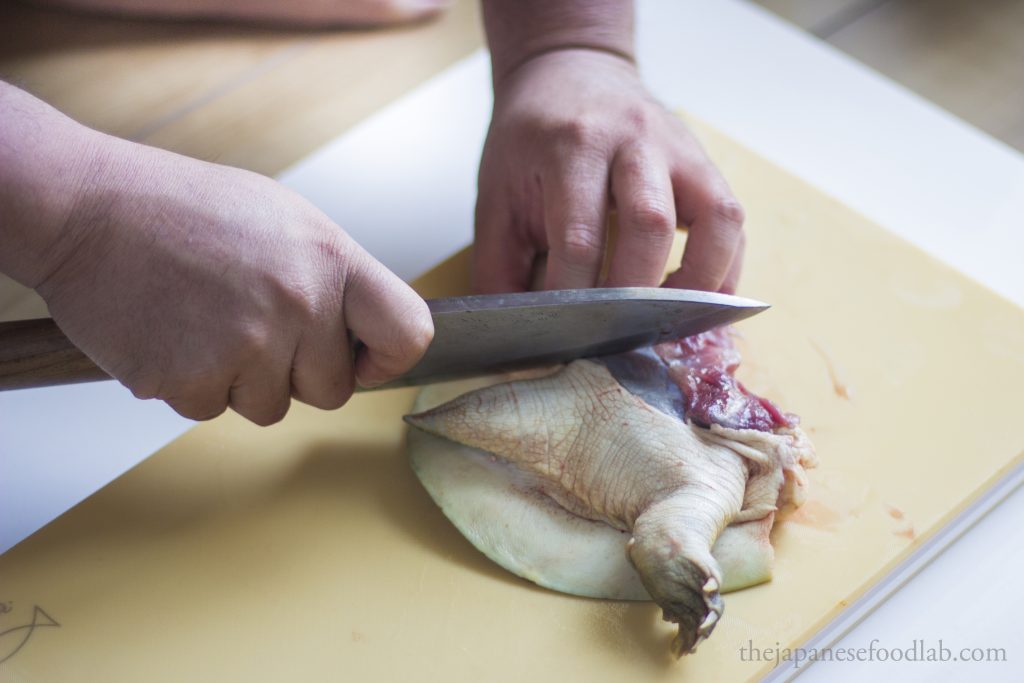
The right hindleg being removed.
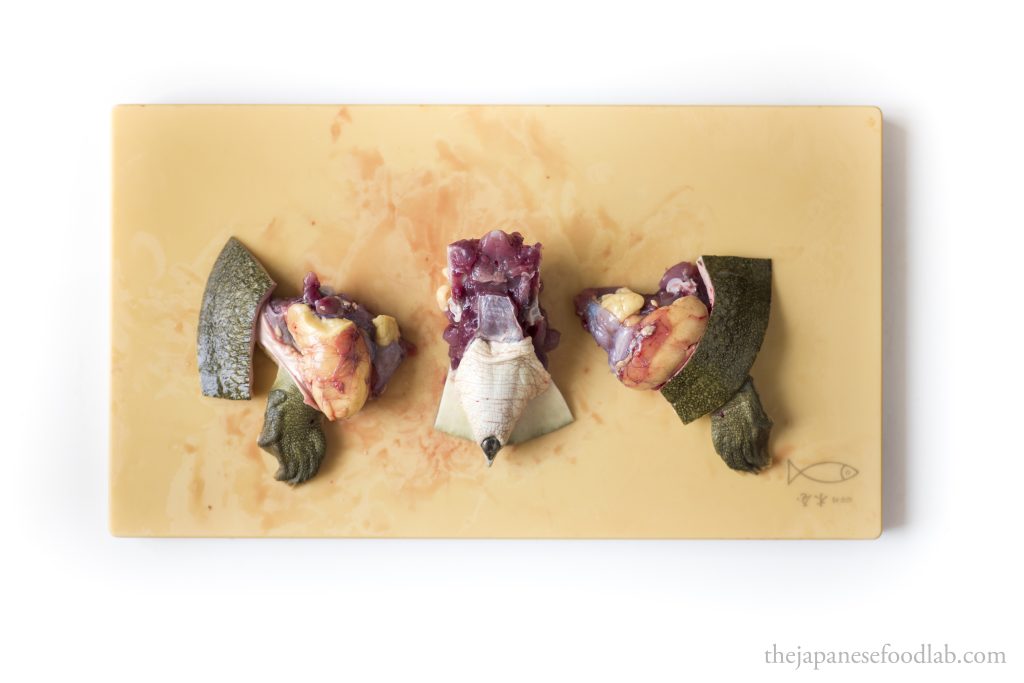
At this point, the bottom section of the suppon should be in three parts.
With the tail section, cut the tail short by 2 to 3 cm to remove the inedible urethra and discard. It will protrude when pressed with a knife.
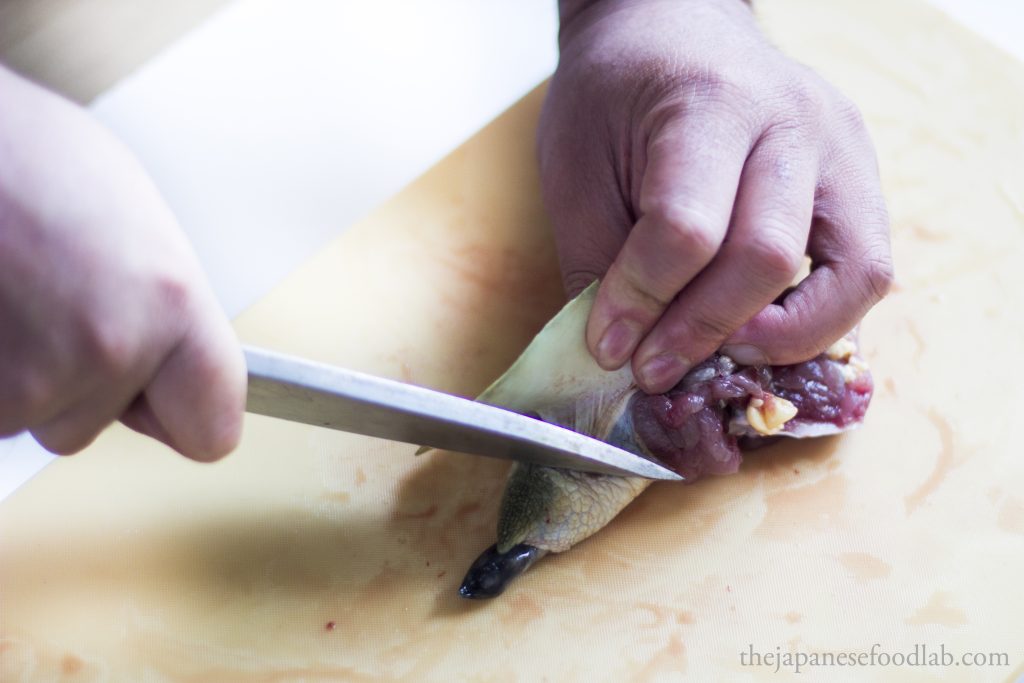
To prepare the hind leg, cut off the claws and discard. This is done by pressing your knife on the claw, and then chopping it off decisely to make one clean cut. The claw is hard and cannot be sliced off.
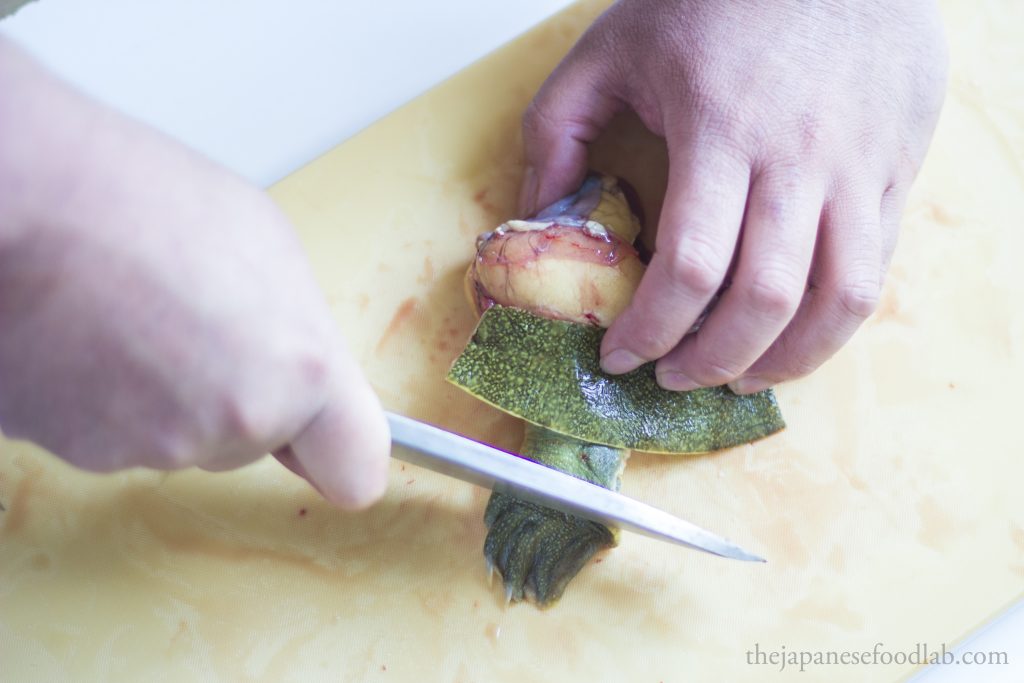
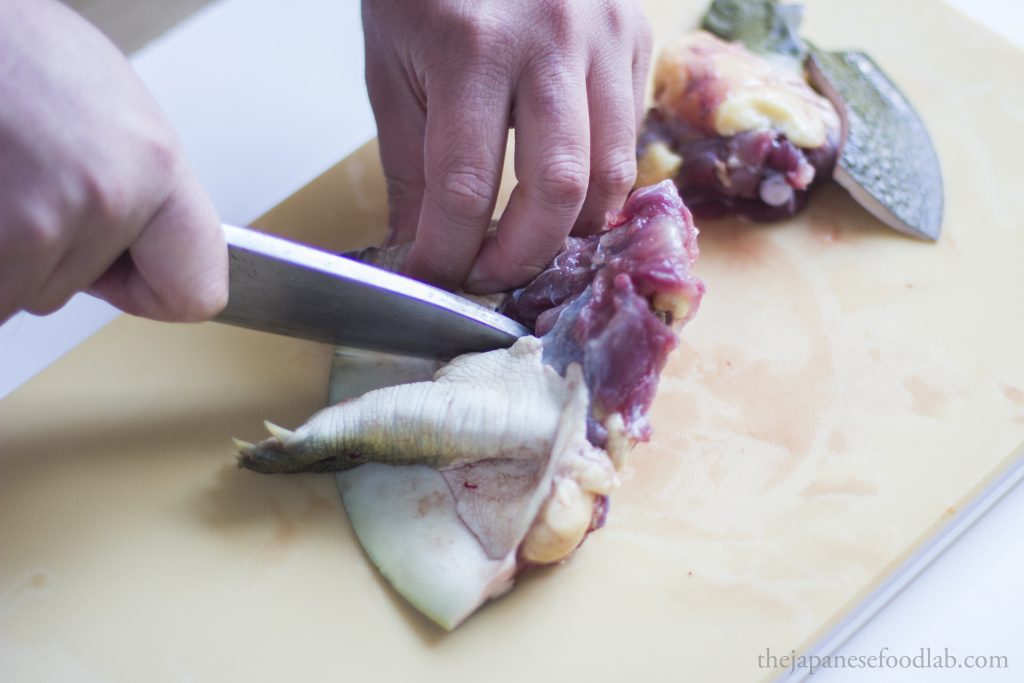
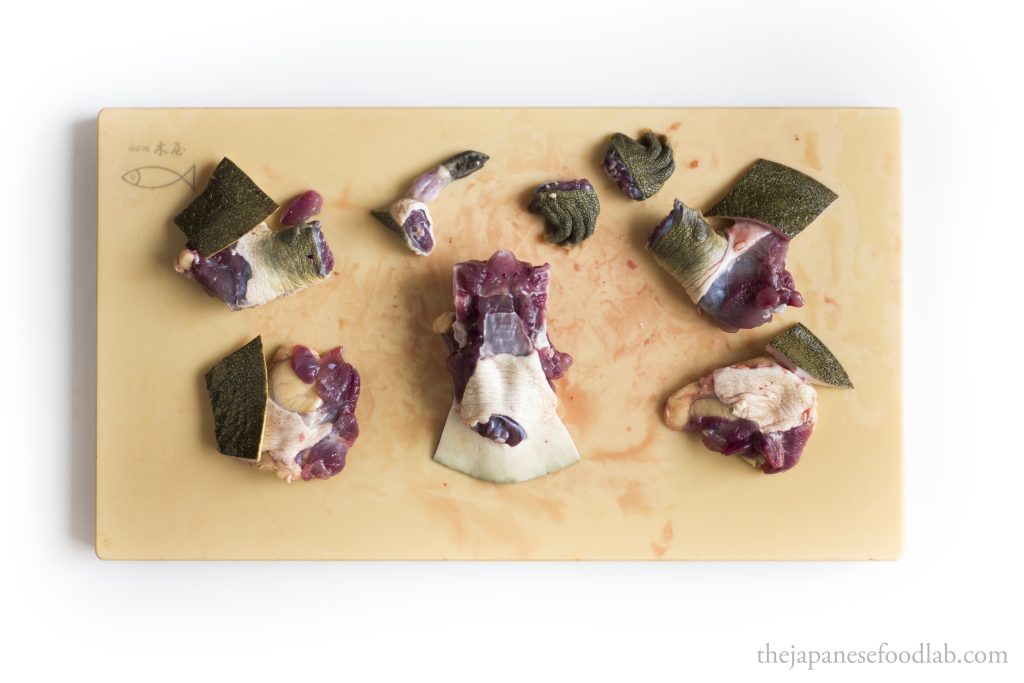
Separate each leg from the thigh into two pieces by cutting at the bone joints and repeat for the other leg.
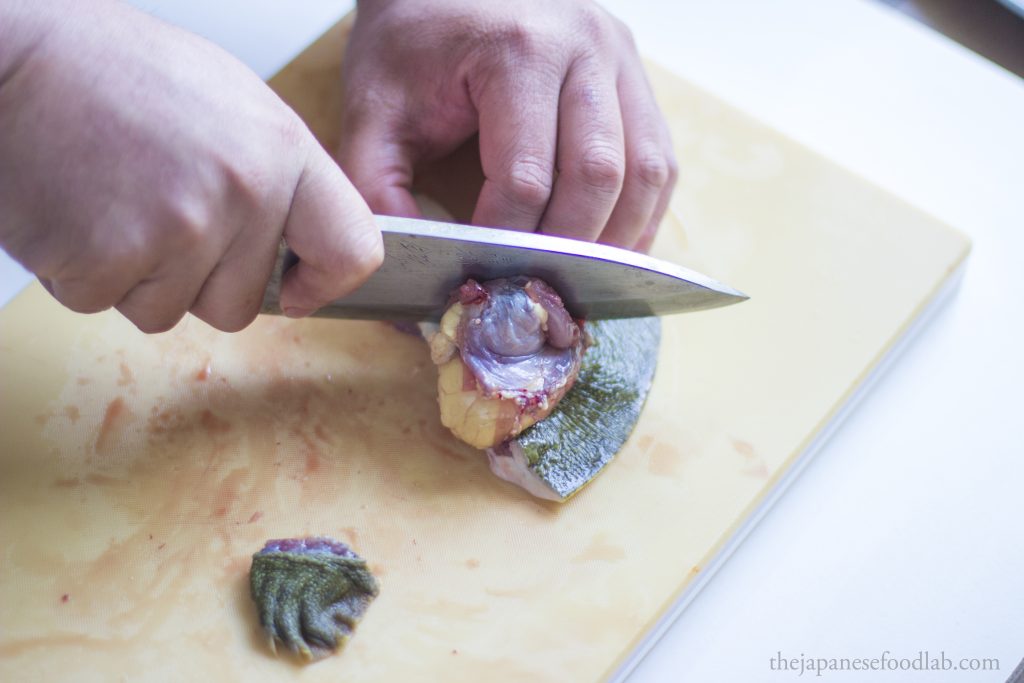
At this point, the hind portion of the suppon should be cut into 5 edible parts and you can discard the two claws and tail.
To prepare the front legs, cut them away from the plastron by slicing your knife between the plastron and legs on both sides, similar to removing the carapace from the body.
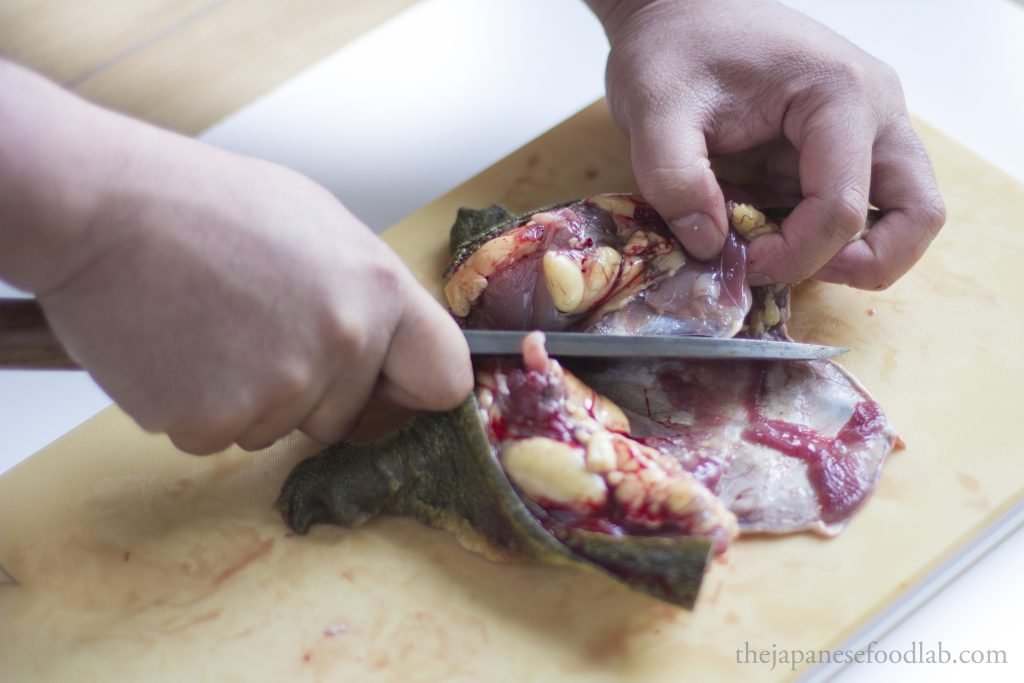
Repeat the slices again and again, slowly releasing the front leg from the plastron.
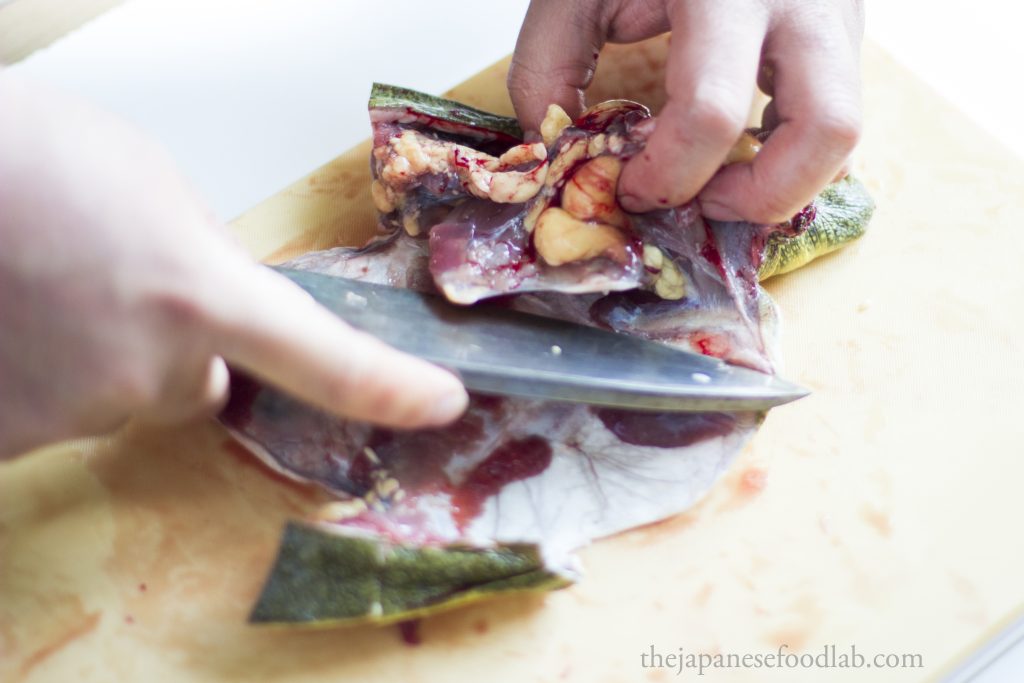
Continue until the leg releases from the plastron.
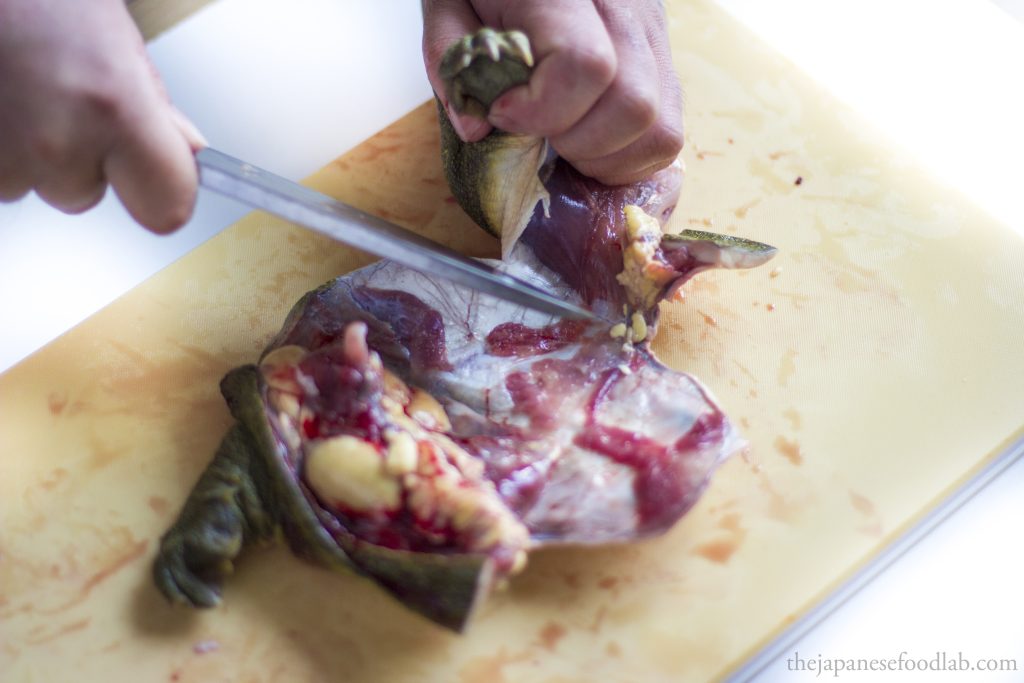
Repeat for the other leg. At the end, you should have three peices. The plastron and two front legs.
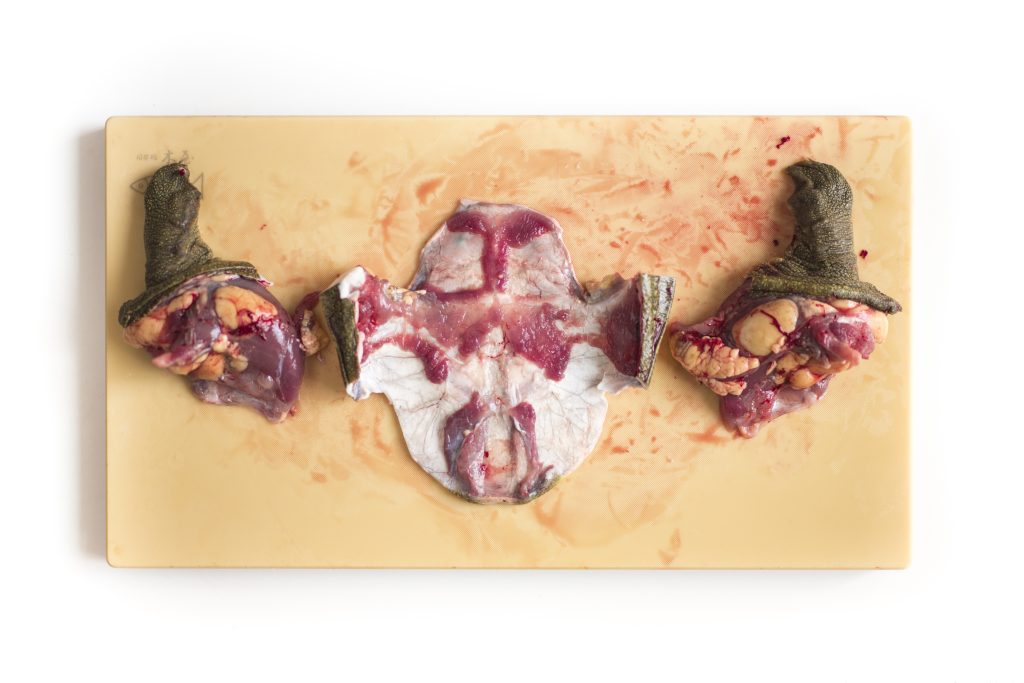
Prepare the front legs like the hindlegs, cutting off the claws first and discarding.
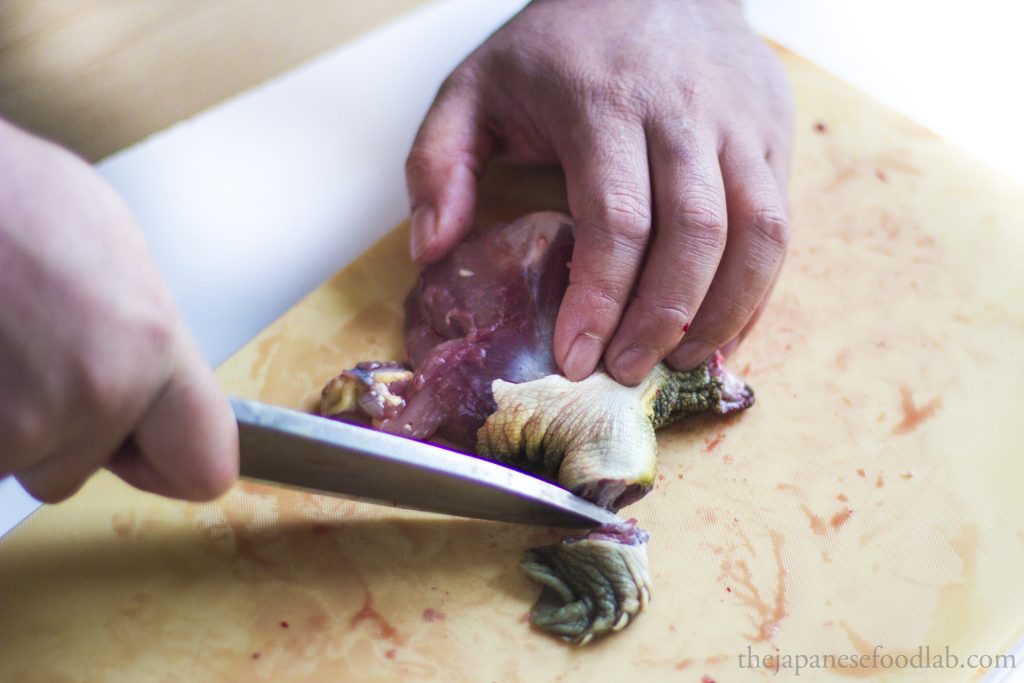
And then Separate each leg from the thigh into two pieces by cutting at the bone joints and repeat for the other leg.
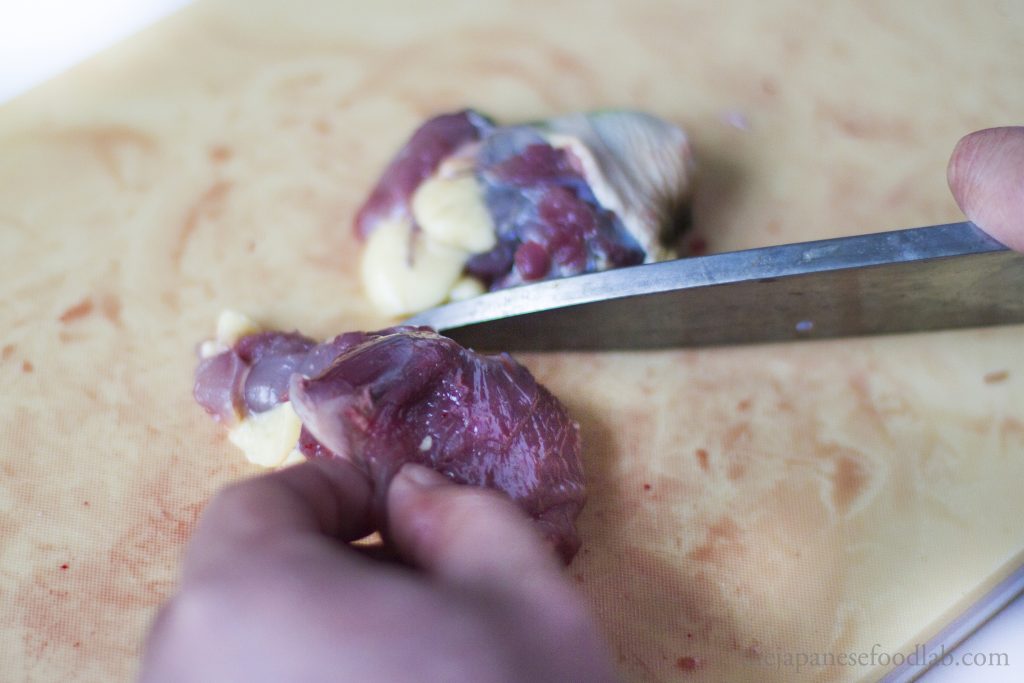
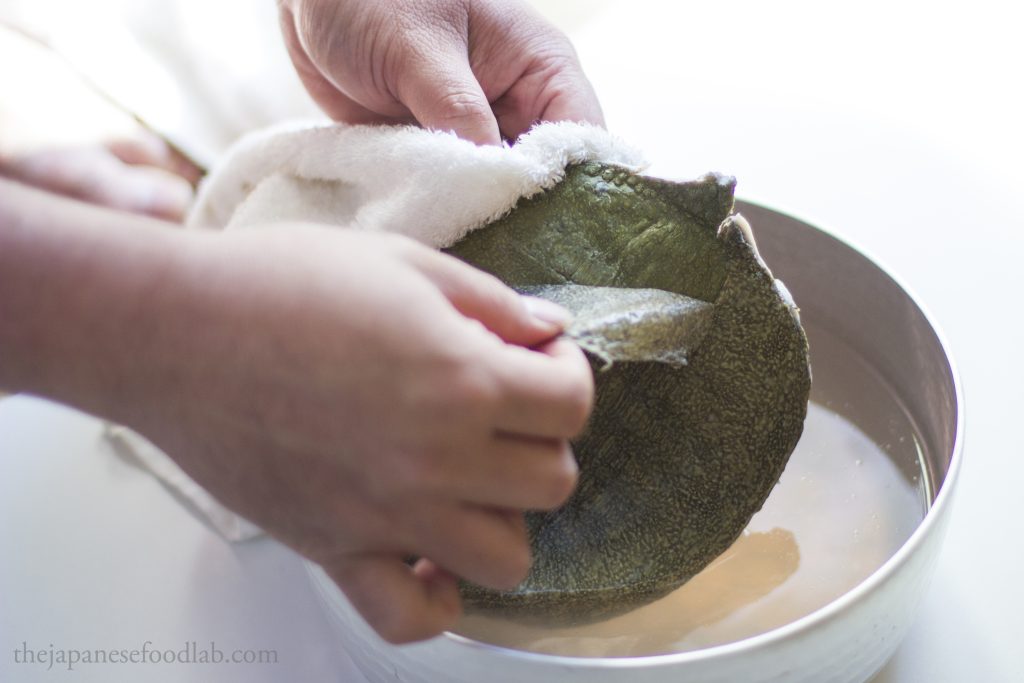
Now for the most important part which is removing the thin outer skin from all the edible pieces. If this is not done, the membrane will either flake off into your stock or remain attached and give the meat a horrible mouthfeel. This is the most tedious part of preparing suppon.
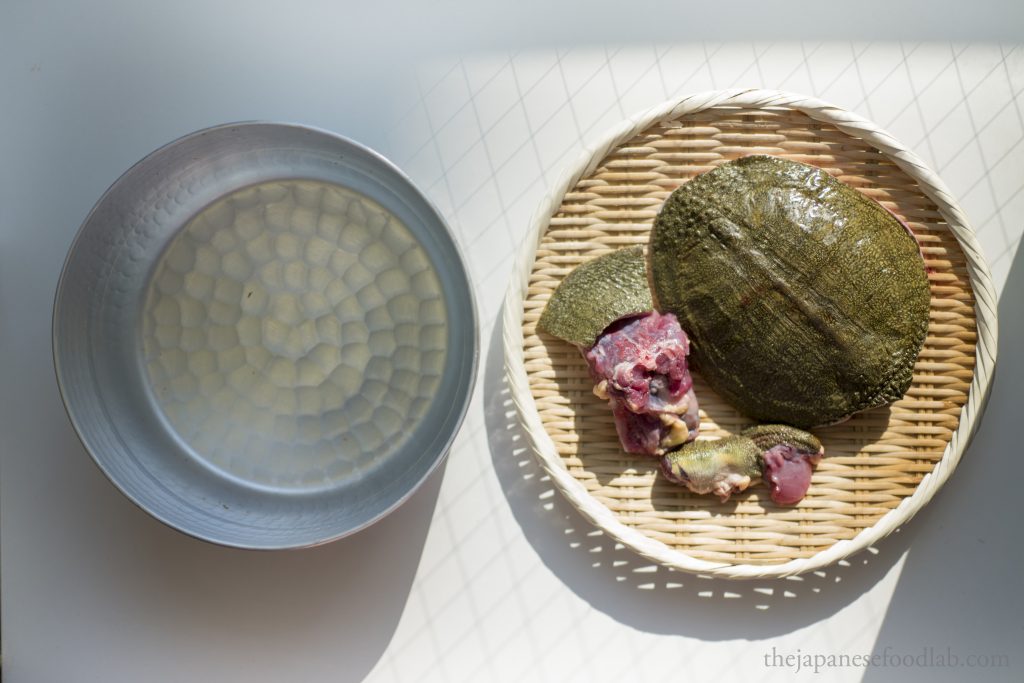
Prepare a large pot of water at 80 to 90°C and submerge each piece (including the plastron and carapace) separately for about a minute and peel away the thin outer skin of the turtle.
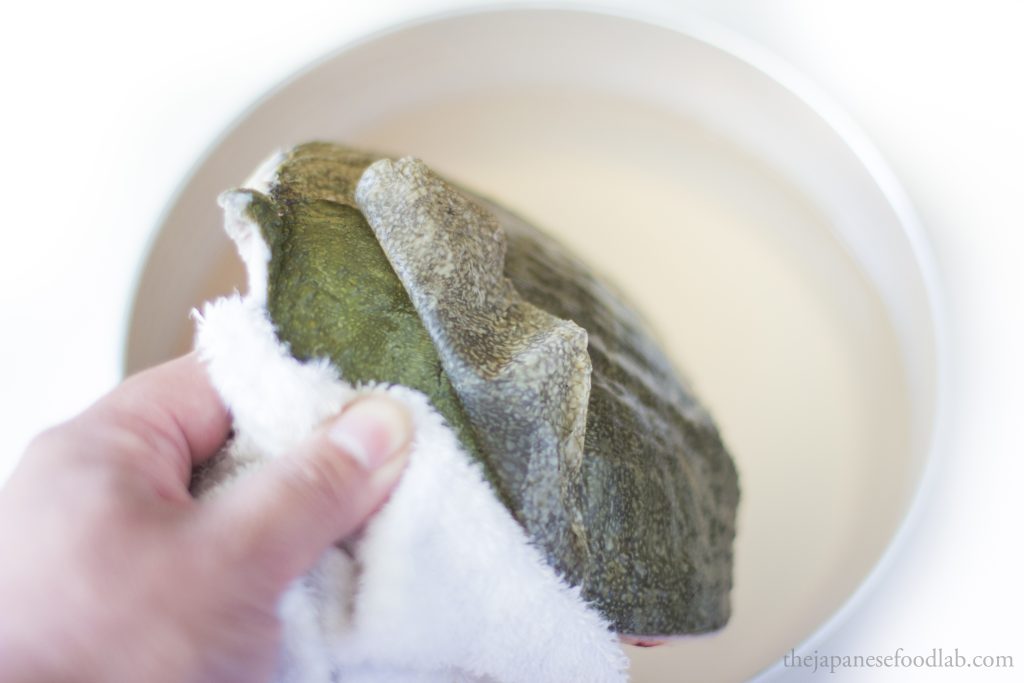
If possible, peel in one go but sometimes the outer skin still breaks. Don’t panic and try to peel as best as you can.
After peeling, transfer to another cold water bath to allow any excess blood to drain.
Repeat for all edible peices.
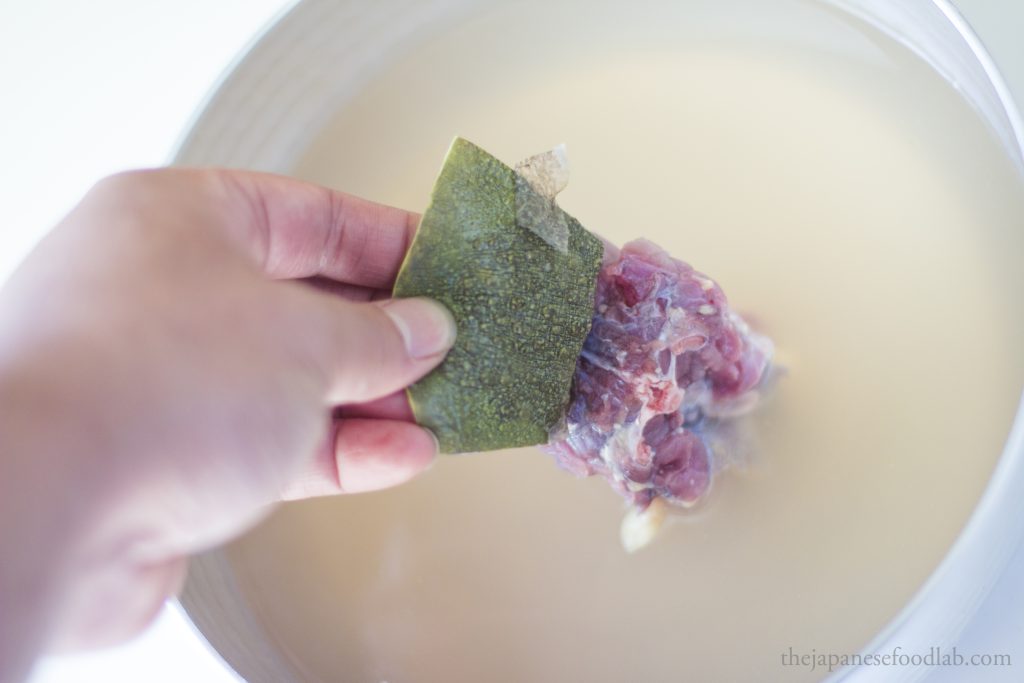
The suppon is now ready to be used for soups or hotpots. If you have the time and resources, we highly recommend Hirasansou’s bear hotpot.
