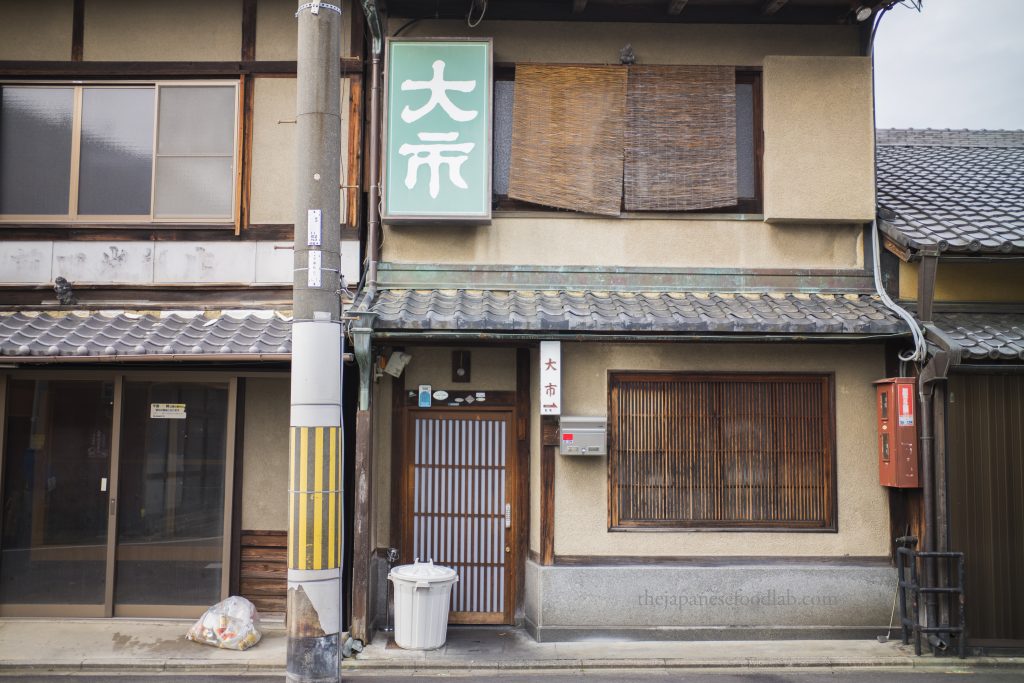
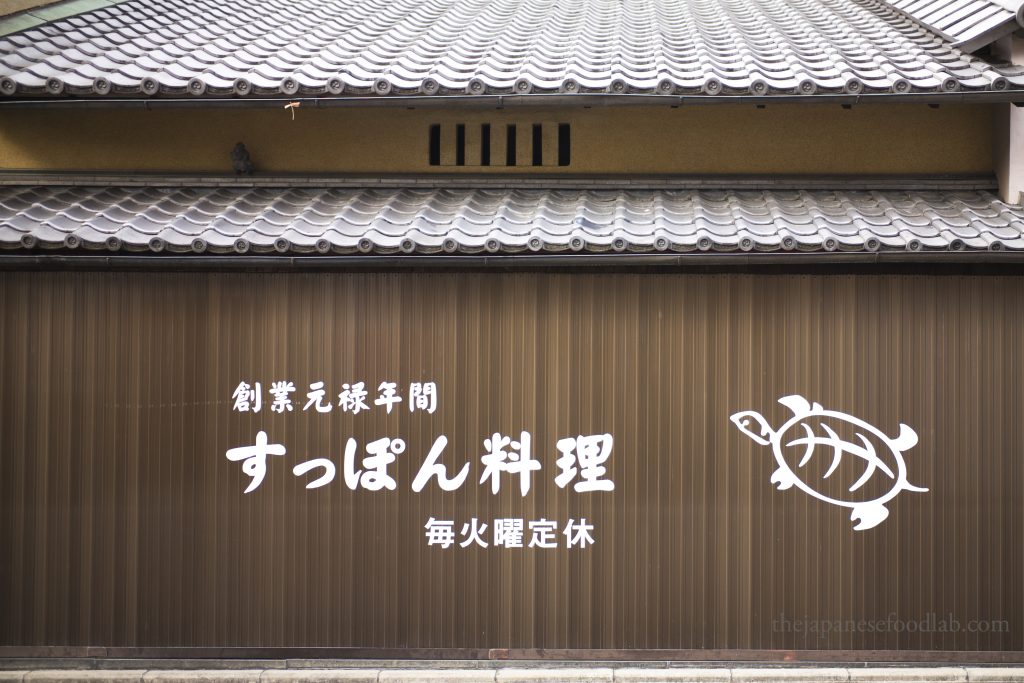
No Suppon article series would be complete without an indepth dive into arguably the most legendary suppon restaurant, Daiichi (大市). Located in Kyoto, it has been in operation for over 300 years and serves a multi-course meal centered around softshelled turtle. However, its signature dish is the suppon nabe served at the end and can also be ordered stand alone for lunch. Opened in 1688, the restaurant has been run by the same family for 18 generations and has historically used wild suppon from Ogura Pond (小倉池) in Kyoto, but has sinced changed to using farmed turtles that have been slowly grown for 4 to 5 years.
On the surface, the recipe for their dish is fairly straightforward. Suppon stock with high quality cooking sake, and seasoned with a blend of soy sauces. Unlike most Maru Nabe (まる鍋), it is served without any additions, with no mushrooms, cabbage, tofu or leeks. However a quick inspection of their cooking process quickly reveals something we had never seen before in a kitchen. Instead of cooking over a charcoal or gas fire, they cook using coke!
For those who are not familiar, coke is a high carbon fuel typically used for smelting iron or steel, rather than for cooking. This is because it heats up to a whopping 1600℃ which would easily burn any dish you’re trying to make whilst severely damaging your cookware at the same time.
When diving a little deeper into this, we found this extremely interesting due to its ties with the history of Japanese smithing and sand iron, which we elaborated on in our article on Kuji Sand Iron Pots. To begin, it first helps to understand that charcoal and coke are actually created in very similar ways. Whilst coke is made from coal and charcoal from wood, both are made by subjecting the raw material to a high heat low oxygen environment so that it doesn’t burn, but instead drives off water and other volatile compounds through a process known as pyrolysis, leaving behind a high carbon fuel.
What makes this extra interesting is that while coke is more commonly used for smelting due to its higher burning temperature, Japan actually didn’t have access to high quality coal to make coke as it just wasn’t naturally available in Japan. So instead, Japan had to invent ways to smelt iron using charcoal. But this is where things seemed to have worked out just right, as Japan didn’t have access to high quality iron ore instead, but only low quality sand iron, which worked out perfectly as charcoal was actually more desirable than coke when smelting with low quality sand iron. This is because coke contains a much higher amount of sulfur and phosphorus, which when incorporated into the steel makes it brittle. This effect isn’t as great when using high quality iron ore, but when using sand iron and trying to make high quality tamahagane, the results would be disastrous. So while we aren’t experts on how this came to be, either by sheer chance or pure ingenuity, Japan was still able to make high quality weapons using the materials that were available to them.
But back to Daiichi, this makes it even more interesting as coke wasn’t even that common in Japan so it was definitely a unique decision to use it over charcoal in a country that arguably makes the highest quality charcoal in the world.
To pair with the technique, only the highest quality donabe cookware would have been able to withstand such high cooking temperatures. Therefore, it is of no surprise that they have specially custom made donabe made by Kumoi Kiln. In fact, we’ve heard from people that it was the willingness of Daiichi to use Nakagawa Ippento’s claypots due to them being able to withstand such high temperatures that made him so famous to begin with, as Daiichi was one of the earliest supporters of his kiln. Of course, this was due to his unique technology at the time to fully glaze the entire claypot, as most claypots are not glazed at the bottom where they meet the heat source. This unique trait is what makes his claypots amongst the most sought after today, alongside his brothers Nakagawa Isshiro and Nakagawa Mutsumi.
Even with such incredible high quality claypots, the cooking process of using coke is still too harsh and we were told that many of the pots end up breaking within the first few uses. In fact, to season and prepare the pots, Daiichi uses a unique method that is almost like artificial selection, first soaking the pots in a mixture of sake and broth for over a month to mature, before allowing them to dry and then subjecting them to the cooking process. The pots that are able to withstand this are then added to the circulation. Still, 1600℃ is still too much even for these claypots, and the bottom of the pots gradually melt together, becoming thinner and thinner before cracking. Daiichi estimates that each of their Kumoi Kiln pots gets around 100 uses before the pot breaks and is no longer usable. In fact, the pots are so essential to Daiichi’s identity that they strongly believed that even if the store burned down, the essence of their dish would never be lost so long as they still had access to the clay pots, and that these very pots have utmost priority to be saved in the event of a disaster.
Then, besides having such a unique story and place in the history of claypot cooking, we additionally noticed a very specific aspect of the cooking process which we feel make the dish unique, even if barely noticed. Firstly, the suppon stock they use is made without ginger and instead, once the dish has been fully cooked, they add a squeeze of ginger juice. In our opinion, this is actually what made all the difference when trying to replicate the dish, as it preserves the freshness of the ginger. The reason is twofold. Firstly, as those familiar with cooking with garlic know, the taste of fresh ginger versus that which has been cooked is very different. Secondly, and more importantly, only fresh young ginger that has not been stored for long periods of time can be sliced into strips and squeezed to release juice, something that we learned many years ago when we first lived in Japan. When we lived in the UK and then in Australia, the ginger sold in the supermarket was always dry and never released any liquid when cut. However, in many parts of Asia, it is possible to obtain fresh ginger that can be squeezed to release a small amount of juice.
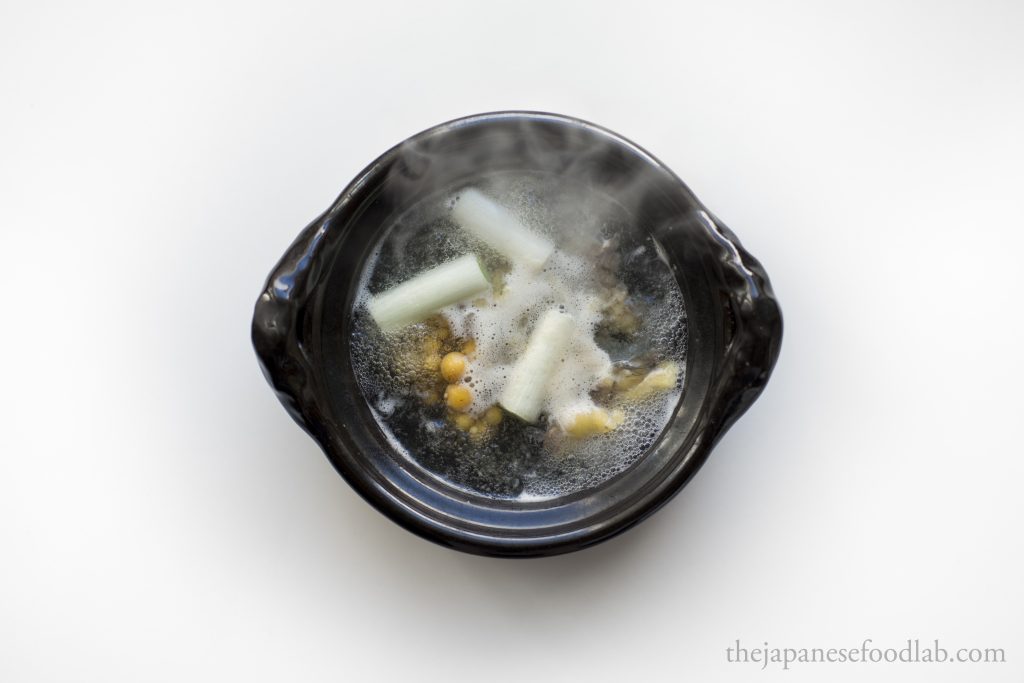
At Daiichi, the suppon stock is made in advance and allowed to chill. When needed, it is reheated over coke in the claypot for around 8 minutes with the meat for around 8 minutes. The coke is first lit up with a gas stove. Once all the meat is eaten, the remaining broth is boiled with fresh rice mochi and eggs to make a zosui porridge to finish off the meal.
Daiichi’s Suppon Marunabe Recipe
Chilled suppon stock (made without ginger)
Chilled suppon meat left over from the suppon stock.
Fresh ginger to taste, julliened
2 Eggs
1 bowl of cooked rice.
2 pieces of rice mochi, fresh if available or kirimochi blocks also work
If using a gas burner, place the suppon stock and meat in a claypot and cook at full blast until fully heated through. Just before serving, squeeze in a generous amount of ginger juice from the julliened ginger. Bring the claypot to the table and first serve the soup for the guest to taste, before serving the meat in a separate bowl. Bring the claypot back to the kitchen adding in the fresh rice mochi before bringing the remaining stock back up to a full boil. Add in the cooked rice and allow it to soften for around 4 minutes. Turn off the heat and add in the eggs to cook with residual heat before serving.

Such an interesting series of articles, keep it up!