As a primer, we recommend reading our article on the difference between tempura and tendon.
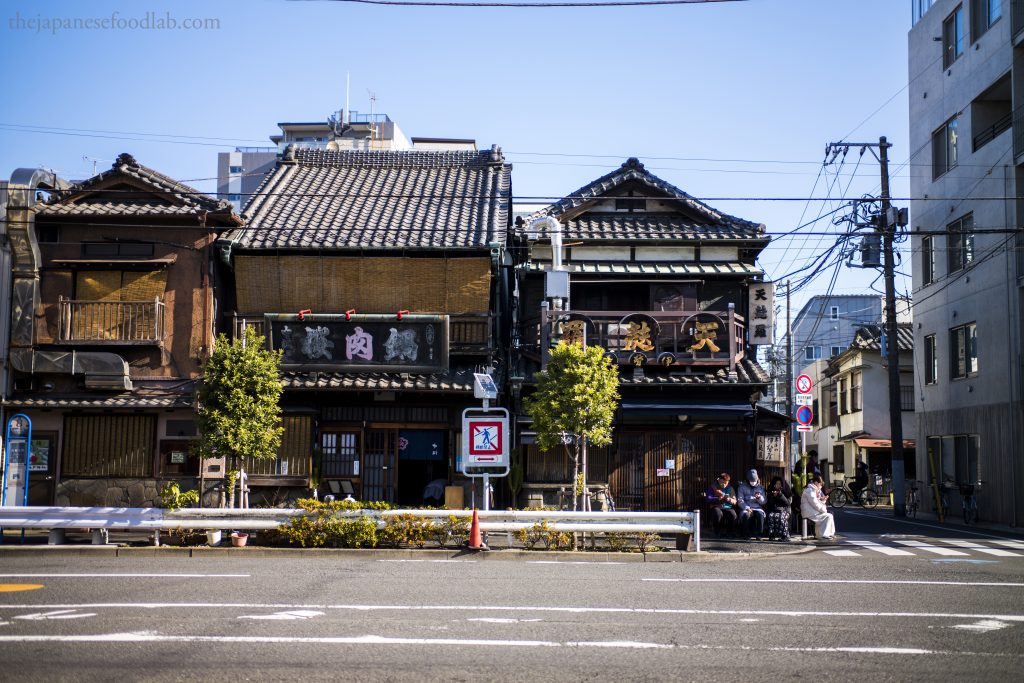
Though we’ve previously covered Tempura chefs who are at the pinnacle of their craft like Shuji Niitome and Tadashi Kusunoki, our series on tempura would not be complete if we did not cover an equivalent tendon restaurant as it is often overlooked by diners who only chase high end restaurants.
It’s harder to think of a more classic example of Tendon other than a meal at Dote no Iseya (土手の伊勢屋), which in our opinion serves the pinnacle of tendon bowls aimed at the everyday masses (excluding tendon bowls serves at tempura counter seat restaurants). To us, a trip to Tokyo is never complete without a pilgrimage to Dote no Iseya.
Founded in 1889, it is still popular today, with long queues starting before the restaurant has opened, enticing diners with the smell of roasted sesame seed oil wafting through the air. Even outside of Japan, there are many tempura or tendon restaurants opened by chefs who have claimed to have first cut their teeth at this temple of tendon, none of which have come close to replicating the quality of the original.
When customers first approach the restaurant, something always strikes them as out of place- the building itself looks stuck in time, made almost entirely out of wood that has darkened with age, almost on the verge of falling apart. The seating inside is cramped, and makes you feel like you’ve gone back in time. Antique artworks and figures adorn the walls, with an old clock that requires manual winding up telling the time. The building itself is said to have been rebuilt in the Showa period after an earthquake and is a registered tangible cultural property. From it’s opening until now, it has been owned and run by descendants of the Wakayabashi family (若林).
What Makes Dote no Iseya Special?
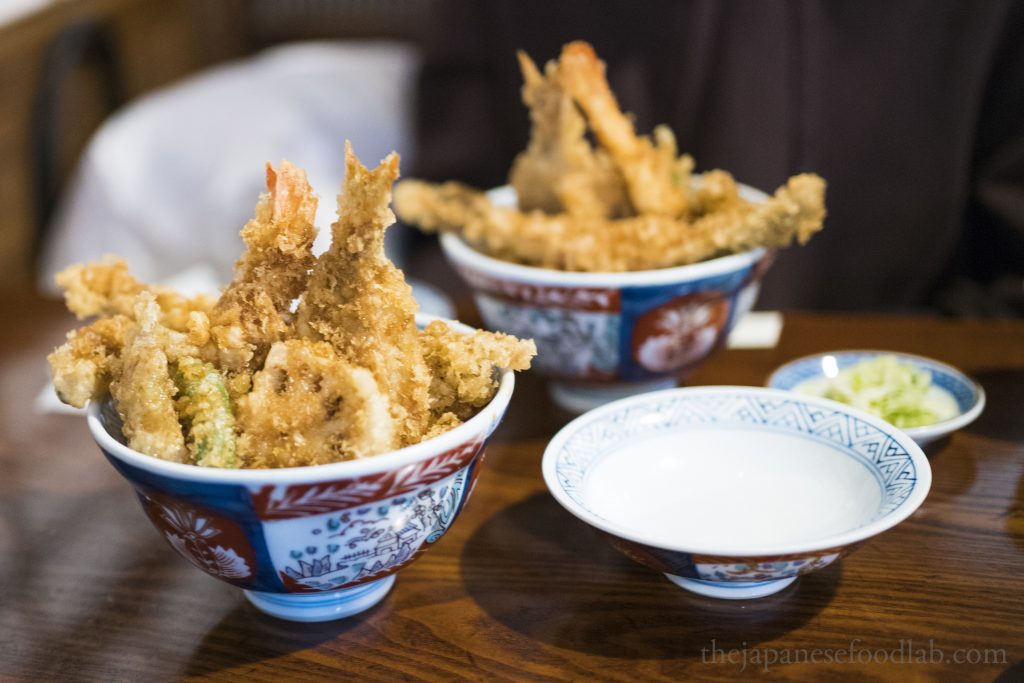
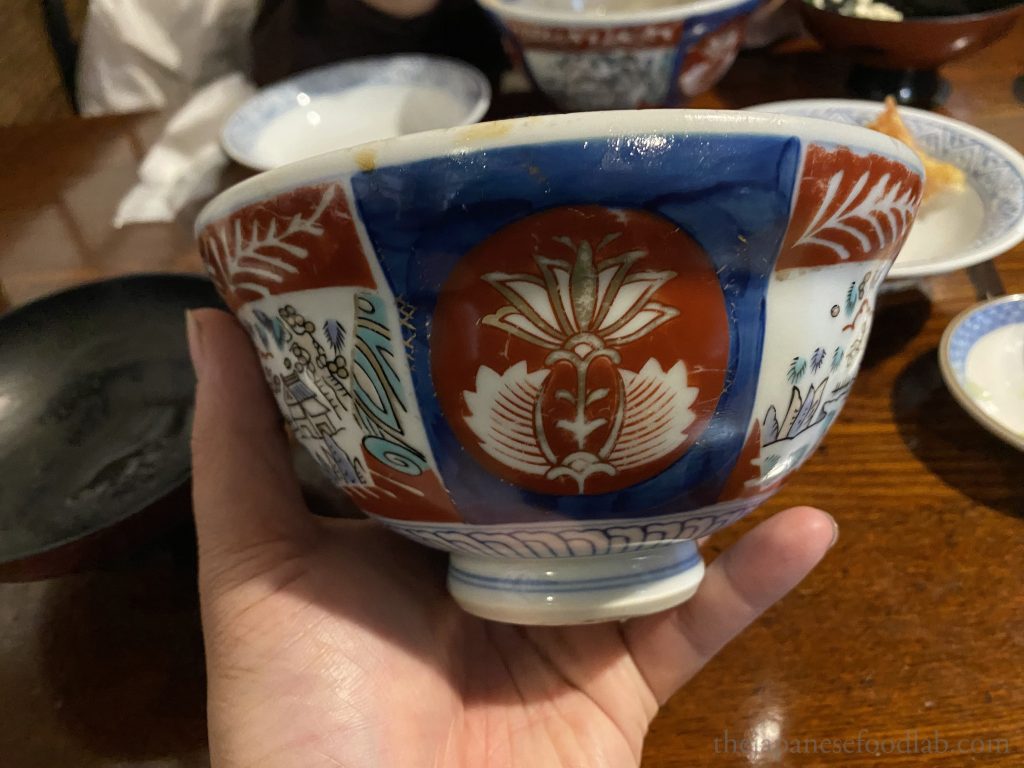
Located in Taito city a little further from most tourist spots, its bowls of tendon are rustic yet satisfying in the most perfect way. They’re served in bowls made from brightly coloured Imari ware (伊万里焼) from Arita prefecture and unconventionally served without a lid. This is because they believe (and we totally agree) that the lid does a worse job trapping steam and making the tempura go soggy rather than the small amount of heat it conserves.
The pieces of tempura are also thoroughly fried with an almost glistening golden brown crust from the blend of roasted sesame seed oil and refined corn oil that they use repeatedly over the course of the day. What we find even more heartwarming is that the rice he uses isn’t just pure Hitomebore, but mixed with a small amount of barley that gives it a more substantial texture that pairs well with tempura.
At a few thousand yen a for a bowl of tendon, the restaurant cannot afford top dollar for the highest quality fish on the market, but this is made up for by the restaurant’s high turnover, with allows it to source fresh fish everyday, with their famous anago sea eel only dispatched and fileted the morning of the day itself. The fish served at the restaurant is also carefully chosen to stand out best when prepared as tempura, even if they are not prized when eaten raw. Examples include Princess Sea Perch (Himekodai/ヒメコダイ) and small sea bream. Some days, if the price is right the restaurant may also serve Hirame.
Dote no Iseya’s Tempura Batter Recipe
Luckily for us, there aren’t any big secrets surrounding Dote no Iseya’s tempura batter as he uses many of the same techniques as other famous restaurants.
What he does do differently is adjust the thickness of the batter to the thicker end of the spectrum by whisking in much more flour compared to a high end tempura restaurant. This is because they believe in a thick and crispy crust that highlights the textural contrast between the inside and outside of the tempura, rather than a thin layer of batter that quickly melts away that is common in high end tempura restaurants today.
We totally agree with this approach, as a thicker batter ultimately allows many pieces of tempura to be piled high in a single bowl without going soggy over time.
Furthermore, he makes a huge portion of batter that is roughly ten times the amount a tempura restaurant would use. We estimate that he uses around 20 eggs per portion. This allows him to last through service without needing to make more batter, which is too time consuming for a restaurant that focuses on maximizing the number of customers served.
To prepare their batter, low protein flour is sieved several times into a container that is allowed to rest in the freezer for two days to remove any excess moisture. Next, a mixture of cold sparkling water and eggs are whisked together until fluffy in a 2:1 ratio on the day itself, and allowed to rest in the fridge until the restaurant opens for the lunch rush.
Just before frying, the flour is passed through a sieve once more as it is whisked to the water and egg mixture. The amount of flour added is not measured but learned from muscle memory, but is generous as to make a thick batter. Once the batter is made, each piece of food is dredged in a thick layer of flour before being coated in batter and quickly transferred into the hot oil before any batter can drip off.
This results in the surface of the hot oil being covered in excess pieces of fried batter that in turn sticks to new pieces being added into the oil, creating a crust with many crispy bits of batter, similar to the flower blooming technique.
At this point, the tempura is fried for a much longer duration compared to high-end restaurants, as the thicker batter requires a longer time in the hot oil to fully cook out the extra moisture and develop a much thicker crust.
To summarize, you’d hopefully recognise the various techniques he uses to prepare his batter that are common to many tempura restaurants and covered in our series. Where it differs is the larger amount of flour added to the batter, the age of the oil that has been reused many times, and the longer duration of frying.
The secret of Dote no Iseya’s Tendon
While tempura restaurants tend to serve their food with tentsuyu dipping sauce, tendon is usually served with a sweet sauce, also known as tendon tare (天丼タレ), that is drizzled over the bowl.
In our opinion, Dote no Iseya’s tendon tare is what sets it apart from many other tendon places. Almost all restaurants follow a standard recipe that combines mirin, soy sauce and dashi in a 1:1:1 ratio, sometimes with some added sugar before reducing it down. Whilst they use the same ingredients, unconventional adjustments to how they handle them leads to unique flavor profile signature to Dote no Iseya.
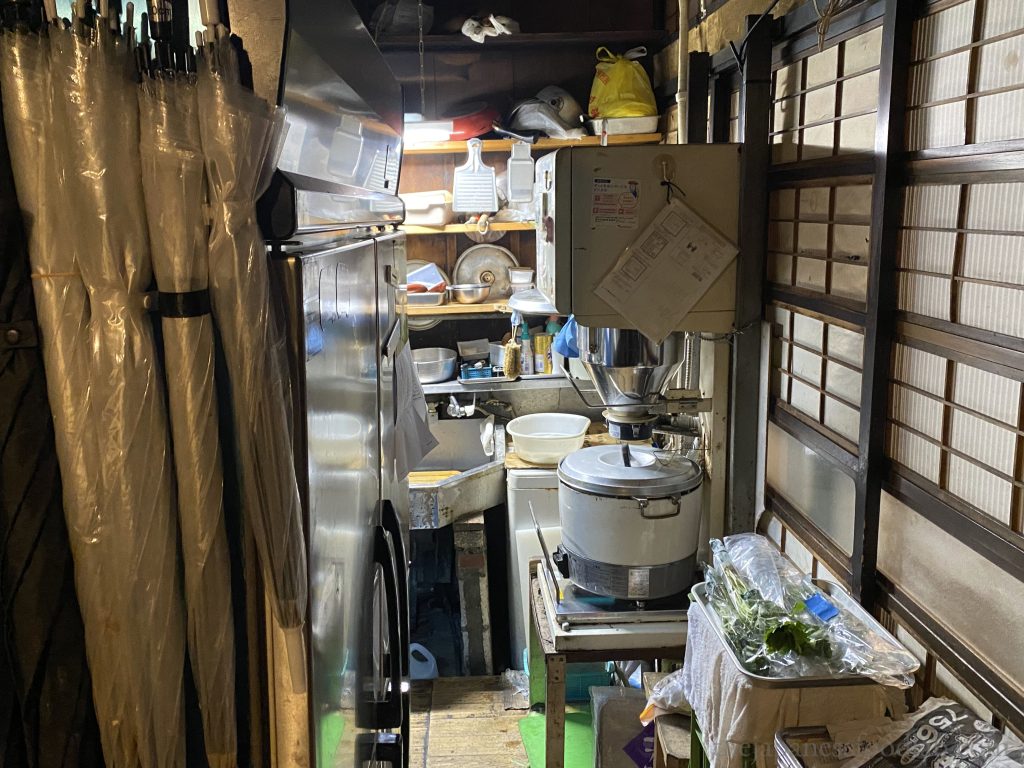
Boiling dashi stock for maximum flavour extraction
The first thing that they do differently is how they prepare their dashi stock. If you’ve read our article on making dashi, or any other famous cookbooks on preparing this fundamental stock in Japanese cuisine, you’ll know how particular the rules are on creating the purest expression of dashi (especially at Kaiseki restaurants). The kombu and katsuobushi must never be allowed to boil, as it can draw out the bitter elements of these ingredients, whilst other chefs even swear by a specific temperature (around 80°C) at which a dashi should be held for optimal flavor extraction. After gentle steeping, the katsuobushi is then strained out and allowed to drain from using its own weight, as any pressing to extract more dashi from the katsuobushi risks releasing impurities into the stock.
However, the Tendon bowl at Dote no Iseya is not meant to be subtle or nuanced, instead, it’s supposed to be rich, filling and satisfying. With this train of thought, they aim straight for maximum extraction of umami and actually boil their kombu for a good few minutes before removing it, and then proceed to add the katsuobushi and boil that too, similar to making dashi from thick cut katsuobushi flakes. If that isn’t sacrilegious enough, they then squeeze the used katsuobushi to extract as much liquid as possible. At this point, most chefs would consider the dashi stock ruined, but the end result is an extremely sumptuous and lip-smacking savory stock that might not be suitable for a fine-dining restaurant, but the perfect base on which to build a sauce to pair with a bowl of deep fried tempura.
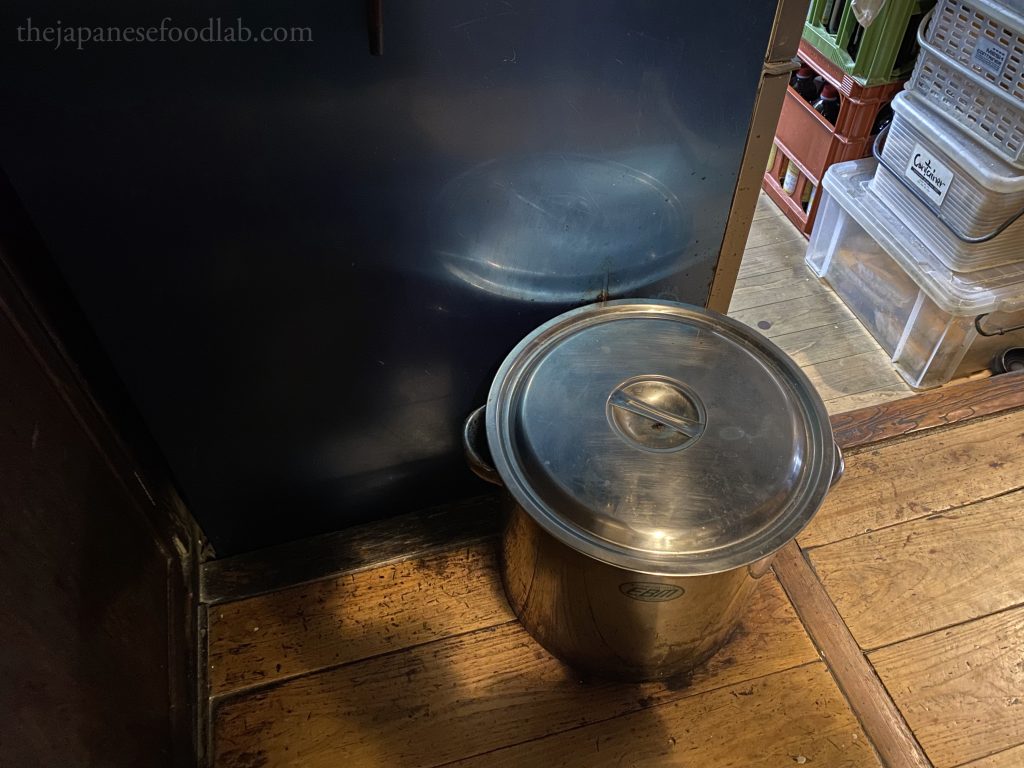
Gozen kaeshi tare
The next intriguing technique that they use lends itself from the world of noodle soups. Rather than adding soy sauce, mirin and sugar directly to the dashi. Many soba soups and dipping sauces are first made by making a mixture known as kaeshi (がえし), which is basically a combination of soy sauce, mirin and sugar without the dashi. The kaeshi is standardized, before being diluted down based on the needs of the dish.
Here, the devil is in the details. Most people would assume that since all four ingredients are going to be mixed together in the end anyway, what difference would it make to mix some of them first. Ask any baker if the sequence in which ingredients are mixed matters and they’d look at you as though you’re crazy. Of course it does and the same applies here.
One method of preparing keashi is known as gozen kaeshi (御膳(前)がえし/ごぜんがえし), whereby the mixture of soy sauce, mirin, and sugar is left to sit at room temperature for a couple of days before being mixed with dashi. By letting the kaeshi age, the flavor of the various ingredients are said to meld together, yielding a far superior taste as compared to simply freshly mixing mirin and soy sauce together.
At Dote no Iseya, the tare is made by mixing the boiled dashi to the aged kaeshi in a 2:1 ratio before adding sugar to taste and allowing it to age for 1 to 2 days. If you visit the restaurant, you might sometimes even spot the secret pot of kaeshi discretely aging in the corner of the restaurant.
What’s interesting is that it appears to be a technique that has gone extinct in the world of soba making, though there are many instances of people lamenting about how great soba made this way was. It also still seems to be practiced in the world of ramen soups.
To validate these claims, we decided to do our own testing to see whether or not this technique actually led to unique results as speculated amongst soba and ramen enthusiasts. From our results, aging a mixture does actually improve the taste of the tare, but with a few caveats.
Just like how the majority of people enjoy the taste of young wine, the taste of older, more mature wine can be an acquired taste, though one that is highly valued by those who enjoy it. This unique taste develops over the years due to a series of slow chemical reactions that occur within the bottle, but also as a small amount of oxygen slowly seeps through the cork or screwcap into the wine, oxidizing various molecules to create new flavors. Soy sauce also undergoes a similar chemical transformation, though it’s often overlooked.*
This is because unlike wine, a bottle of soy sauce isn’t consumed over the course of a single meal. In a household setting, the cap of the bottle is repeatedly opened many many times as it’s used, repeatedly exposing it to fresh oxygen. Its flavour gradually changes little by little, but usually so slowly that it isn’t noticed unless you compare it side by side to a freshly opened bottle of soy sauce.
We wouldn’t say that either of them tastes better than the other, it’s just that they serve a different purpose. In our opinion, we’d prefer the freshest soy sauce with our fish and sashimi, but prefer the taste of oxidised or aged soy sauce for noodle soups.
In a comment on a post in r/ramen on reddit, the famous Ramen_Lord commented in response to the question:
“Some recipes we’ve seen for ramen call for mixing soy sauce and mirin together for the tare and letting it rest overnight before using. Does anyone know why this tastes better than freshly combining it?”
“This is a good question, as I was in the same boat as you, wondering why I kept hearing chefs say this. And then I opened a ramen shop, where we go through 12-16 gallons of soy sauce a week. Soy sauce at that scale is just… kinda different than at home. So here’s my musings on the matter.
My understanding is that this is a bigger deal in a restaurant that is operating at high volume. But there is a unique oxidation effect that occurs as soon as you open a bottle of soy sauce. Most soy sauces don’t have exposure to oxygen until you open them, as a method of preserving flavor. It’s why some soy sauce companies tell you to refrigerate the soy after opening, to preserve that fresh flavor. You do this for wine too, right?
But some chefs LIKE the oxidized, older flavor. And capturing that flavor, when you’re going through so much soy sauce, or, in my case, using literal cubes of soy sauce that have deoxygenated bags in them, can be difficult in a restaurant setting. So we combine and make tare far in advance to start the aging process.
Some of this is also just lore. At Eifukucho Taishoken, one of the oldest shops in Japan, they keep containers of soy sauce for 4 years before using. That’s just a ritual they do now.
It’s worth noting that some soy sauces also have alcohol added as a preservative. Letting the soy and mirin sit in a bigger container helps some of that alcohol evaporate.
In my opinion… I wouldn’t sweat this.”
Dote no Iseya’s Tendon Tare Recipe
First begin by making the gozen kaeshi (御膳返し):
18 litres soy sauce : 1.8 litres of mirin : 3.75kg of sugar
The recipe above is for a commercial amount but it keeps well in the fridge. Combine all three ingredients together and stir to dissolve all the sugar. Pour into a container, cover and allow to sit at room temperature for 1 to 2 days.
Next, make a dashi stock as described in our thick shaved dashi stock article.
Combine the tare together by adding 2 parts dashi to every 1 part kaeshi. Add more sugar to taste and bring to a simmer to fully dissolve the sugar.
Once reduced to your desired consistency, allow to cool and drizzle over freshly fried tendon.
Articles like this require many hours of research and testing in order to be written up to a standard that we feel is good enough for you to enjoy. If you like to support our future work, consider subscribing to our Patreon.
*Just as a clarification, when we refer to aged soy sauce or kaeshi in this article, we’re talking about letting it oxidise naturally over time in a kitchen environment. This is very different from aged soy sauce that is allowed to ferment for greater periods of time in wooden barrels at the factory. If you’re interested in this kind of aging, check out our miso series.
