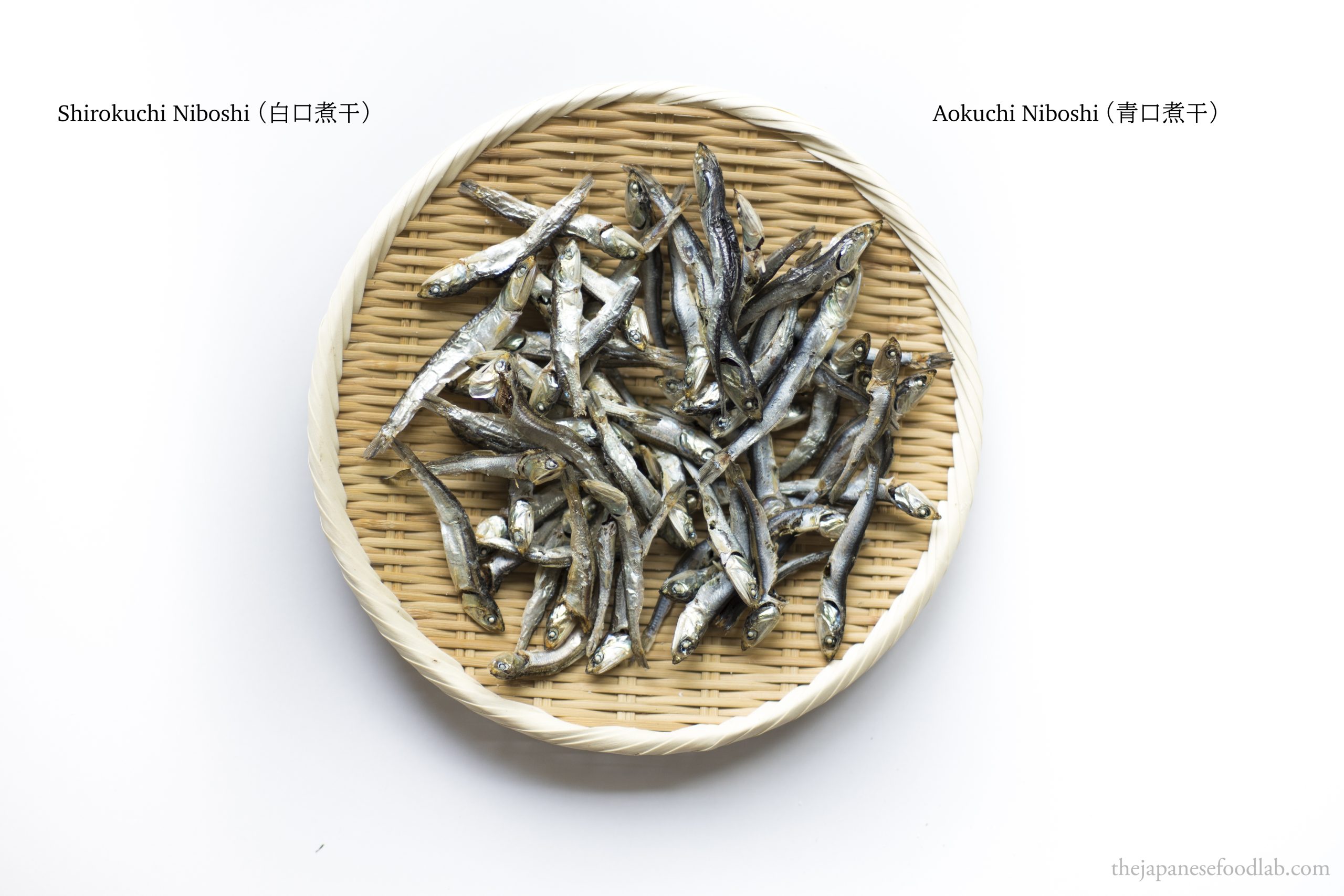
Distinguishing between anchovies and sardines is already difficult enough, yet alone doing so for a myriad of unfamiliar Japanese fish. Therefore, we thought to start off with some basic terminology classification.
From a biological classification point of view, the most straightforward rule of thumb here is that any fish in the Engraulidae family is an anchovy, whereas the term ‘sardine’ is vague and can refer to several different forms of families in the Clupeiform order including Alosidae, Clupeidae and Dussumieriidae. In other words, ‘sardine’ is a common culinary term and doesn’t really mean much, rather than a formal taxonomic grouping.
If anything, our impression of the word iwashi (鰯/イワシ) is that it’s even more vague, and is similarly not the name of a single biological family but just refers to any small Japanese oily fish that lives in schools.

What is Niboshi and Iriko?
Of the many different types of iwashi in Japan, many of them are first boiled, then dried as as a method of preservation, turning them into niboshi (煮干し). They can sometimes be further grilled to impart a smoky flavour. Whilst niboshi can then sometimes be consumed (as in the case of tai niboshi), most are then simmered in water to make dashi.
The fish most people are familiar with is maiwashi (マイワシ), Sardinops sagax, or true sardine in english. As this is part of the Alosidae family, it is a sardine, and is the most commonly eaten sardine for sushi and sashimi. However, whilst it is sometimes made into Niboshi known as hirago niboshi (平子煮干し), it is far from the most delicious in this form, with the most commonly made niboshi being made from katakuchi iwashi (カタクチイワシ), Engraulis japonicus, the Japanese anchovy. Note here how this is also called an iwashi but is actually an anchovy.
It is therefore important not to translate niboshi simply as ‘dried sardines’. While this translation is common, it is often biologically inaccurate, since the most widely used niboshi is made from katakuchi-iwashi.
In western Japan, particularly around the Seto Inland Sea and Shikoku, niboshi made from small fish is also commonly called iriko (いりこ), which we dive into more detail in later articles.
Learn more about different ingredients that go into dashi and other types of niboshi.
